A strange perceptual aftertaste.
If I was an alien writing back to my homeland I would begin the essay with something like this.
We live in a world where the news about people who have been to space is relegated to an obscure publication known as “Space Daily” which is different from “SpaceWar Daily” also part of Space Media. Thankfully, as far as I know, I am not an alien. That's always a fun thing to say when people ask: what do you do? Or “what do you do for a living?” I breathe and as far as I know I am not an alien.
My alien friends back home would be amused by my writings. They would burst out in laughter often sounding rather insane. That’s why I think I hear insane laughter in the recesses of my mind. It not loud. It’s not even audible. It’s difficult to describe. Just inaudible sound of laughter. Anyway, the article goes on to describe the various ailments and maladies that the astronauts suffer from after the return from space. I have experienced all of it without having been in space. The symptoms are highly specific and would be difficult to fake.
+++++++++++++++++++
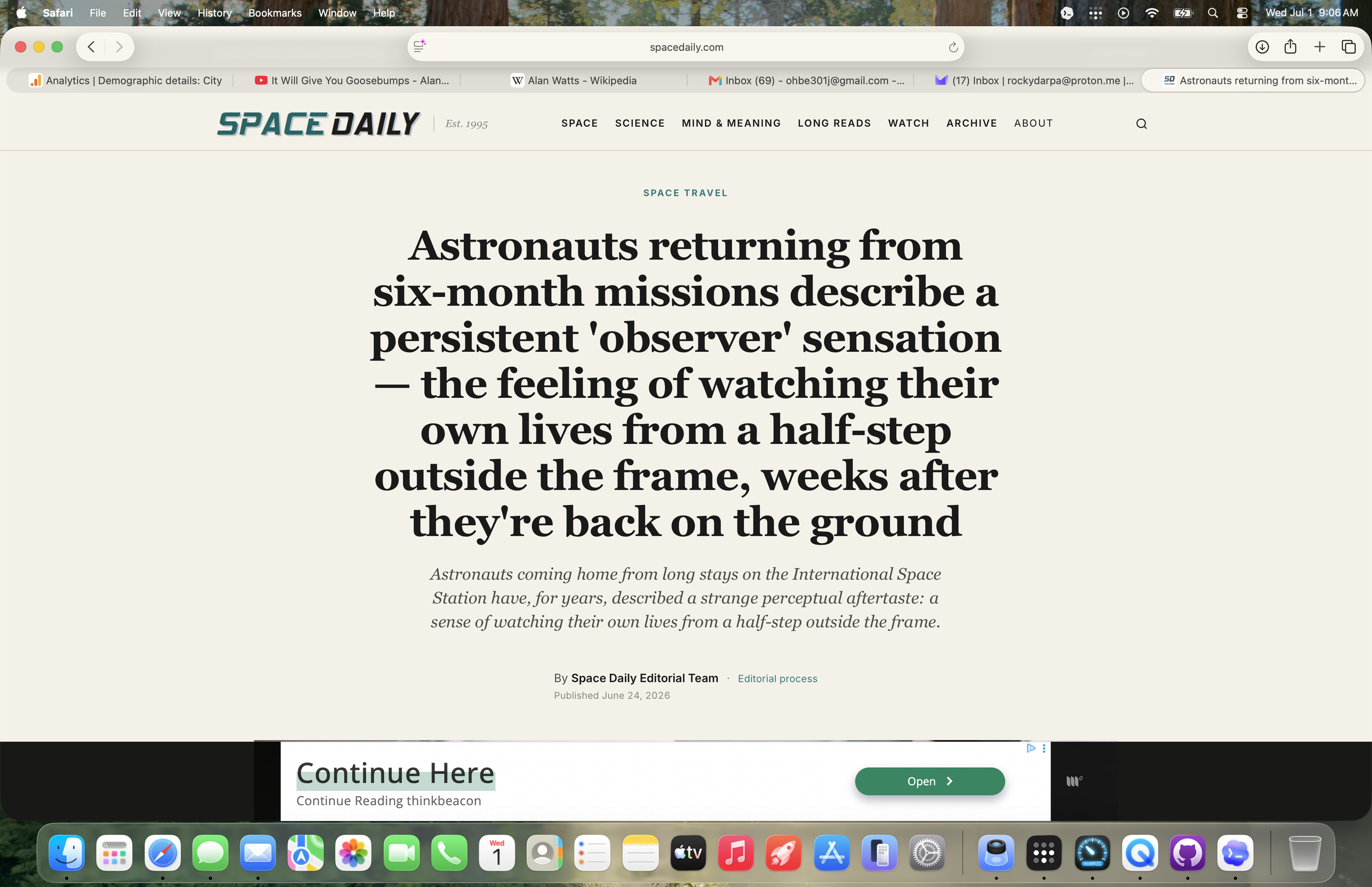
Astronauts coming home from long stays on the International Space Station have, for years, described a strange perceptual aftertaste: a sense of watching their own lives from a half-step outside the frame. They sit at dinner with family and feel like a guest. They drive on a familiar street and feel like they’re piloting it. The room is loud and they are in it, but a part of them is hovering near the ceiling, taking notes.
++++++++++++++++++++
Yeap. In my case it was not the ceiling. Yet I could project myself to any part of the room or anywhere else. I could see my body (or sense seeing my body) after projecting. Imagine sitting at a desk and in front of you is a TV monitor. I can project and imagine seeing an image of me sitting from the vantage of the TV monitor. Like a reverse lookup on Google
+++++++++++++++++++++++++++++++++++++++++++++++
It is not a clinical diagnosis. It does not appear in a DSM. But flight surgeons and crew psychologists who debrief astronauts after six-month rotations describe it often enough that it has become a recognizable readjustment pattern — an observer sensation that lingers for weeks, sometimes months, after splashdown.
What returning crews actually describe
The descriptions are remarkably consistent across agencies. Crew members talk about feeling slightly delayed in conversations. They report a doubled awareness — being present while also watching themselves be present. Some say it feels like the first week of a new job that never quite ends. Others compare it to jet lag of the self.
NASA’s own post-flight reflections from station crews describe the sensation in plainer language: home feels staged. Smells are too sharp. Gravity feels theatrical. The brain, which spent half a year recalibrating for a world without down, treats the familiar as something to be studied rather than inhabited.
Returning astronauts describe walking into their own homes and feeling like they are visiting them. Some talk about being unable to put a glass down without watching their hands do it. The pattern shows up in oral histories, in memoirs, in flight surgeon notes. It is one of the quieter costs of long-duration spaceflight.
Why six months is the threshold
Six months is roughly the standard Expedition rotation aboard the ISS, and it is also the window where neurological adaptation becomes deep enough to require real undoing. The brain in microgravity rewires fast. The vestibular system, deprived of a consistent gravitational reference, stops trusting the inner ear and starts privileging vision. Proprioception — the sense of where your limbs are without looking — degrades. The visual cortex takes on extra work. When the astronaut comes home, all of that has to reverse, and the reversal is not symmetrical with the adaptation.
Long-duration spaceflight takes a measurable physiological toll: bone density loss, fluid shifts that reshape the optic nerve, muscle atrophy that takes months of physiotherapy to undo. The observer sensation sits alongside these as the perceptual cousin of the physical readjustment.
The flight surgeon’s view
NASA’s crew health protocols track astronauts across dozens of metrics from launch through years post-landing. Cognitive testing, mood inventories, sleep tracking, and structured debriefs all feed into a longitudinal record. The observer sensation is not a checkbox on the form, but it shows up in the open-ended sections — some astronauts report feelings of depersonalization or detachment during their readjustment period, according to patterns flight surgeons have observed, with some describing sensations of observing their own lives rather than fully participating in them often enough that flight surgeons recognize it as a pattern rather than an outlier.
What flight surgeons watch for is whether the sensation resolves on its own or whether it lingers into the kind of persistent dissociation that needs intervention. For most crews, flight surgeons report it appears to fade within several weeks to a couple months. For some, particularly those returning from longer missions or from particularly isolated rotations, it can stretch longer.
https://spacedaily.com/sd-v-astronauts-returning-from-six-month-missions-describe-a-persistent-observer-sensation-the-feeling-of-watching-their-own-lives-from-a-half-step-outside-the-frame-weeks-after-theyr/
It watches you walk to the car. It watches you hug your family. It watches the strawberry. And then, slowly, week by week, it puts the camera down.
+++++++++++++++++++++++++++++++++++++++++++++
The slight delay in conversations: yeap. Sometimes the delay is much longer. Sometimes comprehension is much longer. I might hear a doctor speak and in spite of focusing really hard the words would make no sense.
Doc: take 1…. gibberish…. gibberish…. floating away… gibberish… focus…. gibberish… what? focus… gibberish…
Me: uh…pointing at the prescription… what did you say… squinting my eyes really hard… gibberish…. what….
Doc grinning: Look unlike you I have a job. I can’t discuss this again.
Me: feeling hurt but we only discussed this once… and I didn’t understand a damn thing you said...what’s wrong with me?
I no longer have the sensations of multiples of me walking behind me (8 or 9 me behind). I no longer fly into the sun and beyond. I no longer collect people from different parts of the world, combine with them and fly into the sun and beyond. Some of those sensations were truly extraordinary. I still do touch trees and breathe with them. I no longer have something jump out of me and go into a plant and then look back at me from the plant.
Things are much better nowadays. Although to this day I can switch to expanded consciousness at will. It’s difficult to describe. And it’s very pleasant. If I want I could sit anywhere and simply not be within the body. I would just be everywhere. I have tried to record videos of me talking during such events on YouTube Channel ROCKY301J.
I prefer to let the “environment” do the talking while I go back home and watch the video again later. https://www.youtube.com/@R301J
This video by Alan Watts is probably among his best. Although I could be wrong. He doesn’t speak the language of disassociation yet he does. The composition of the words are extraordinarily beautiful and if they were spontaneous then even more so.
