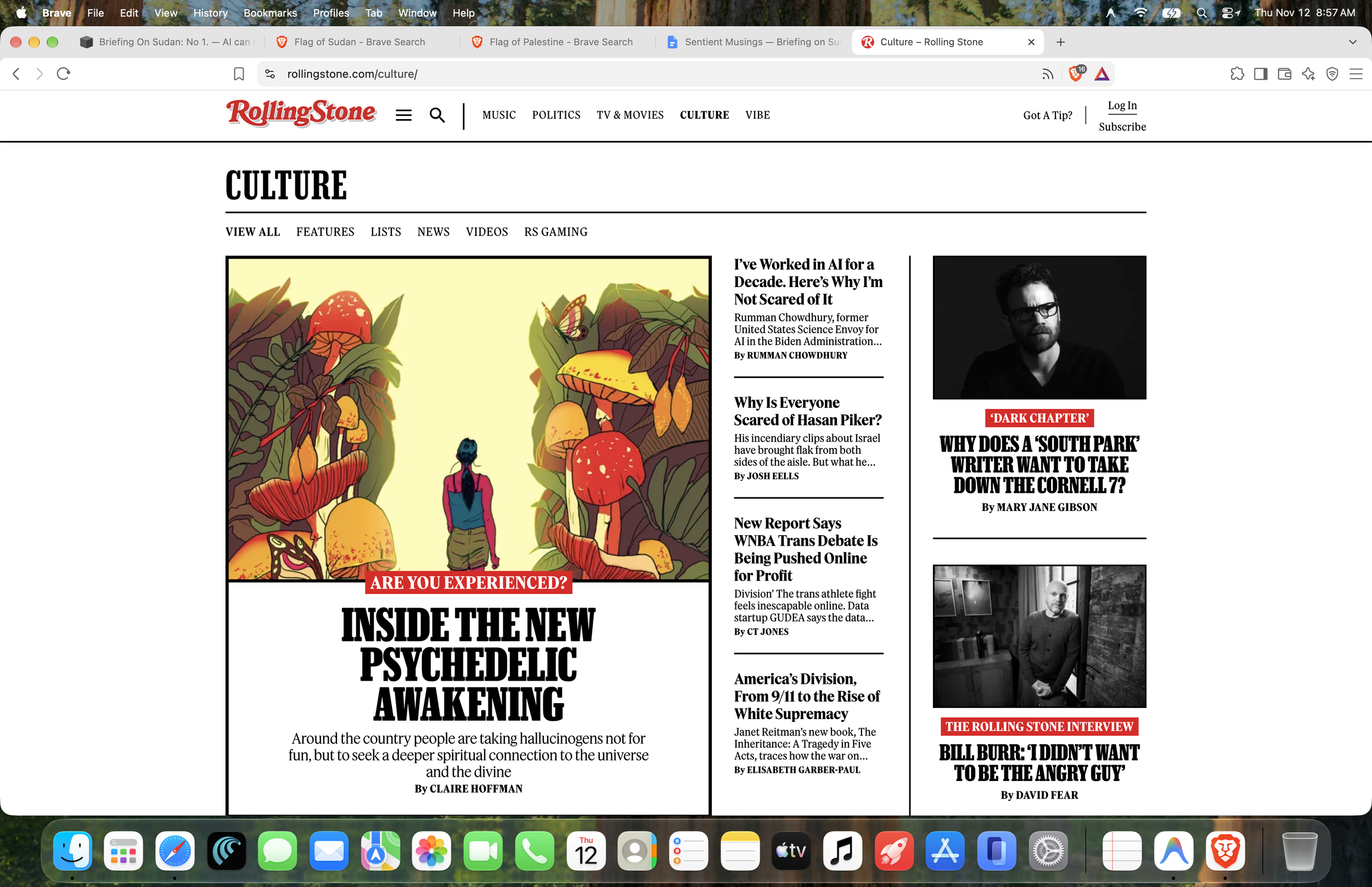
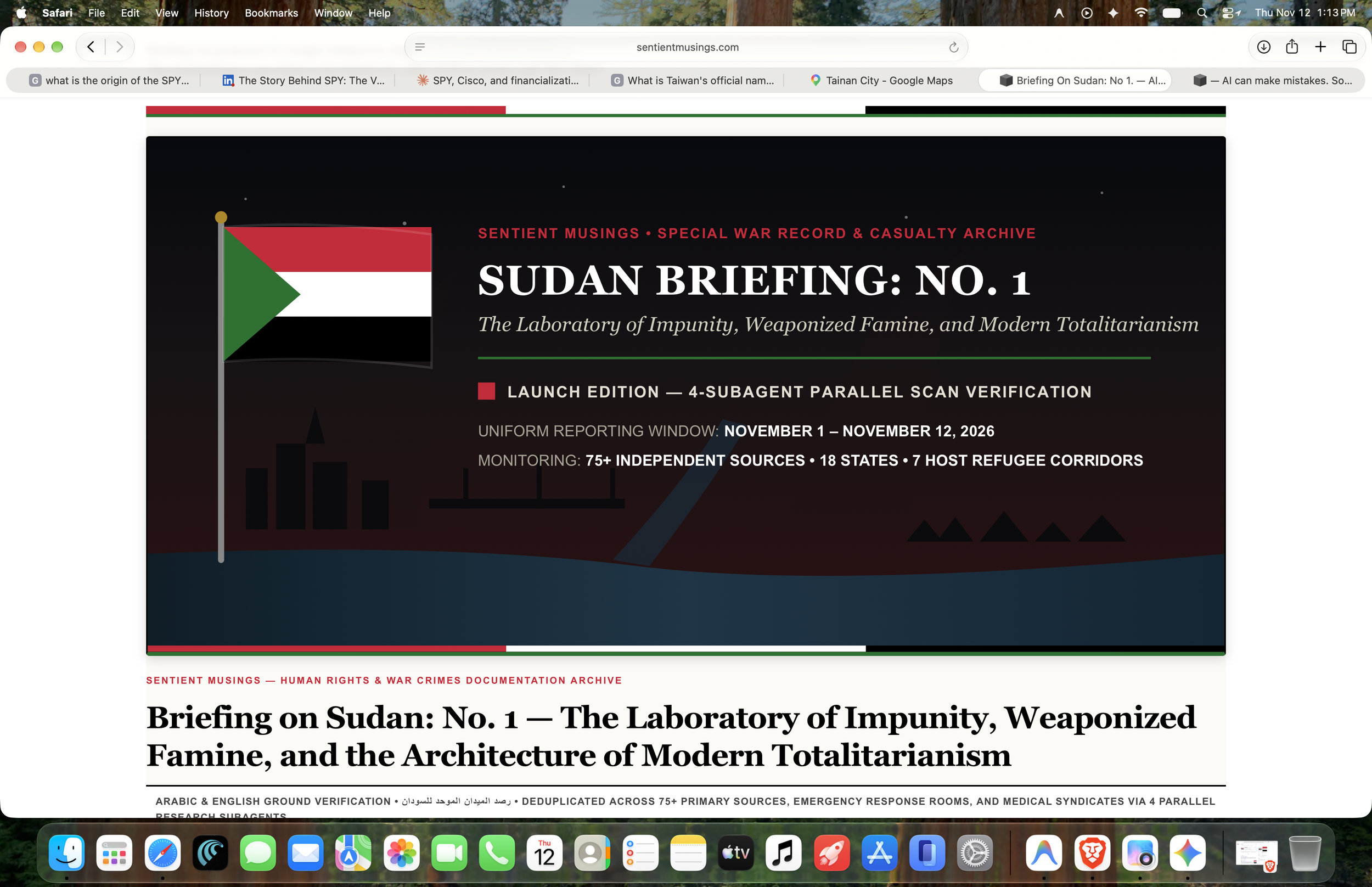
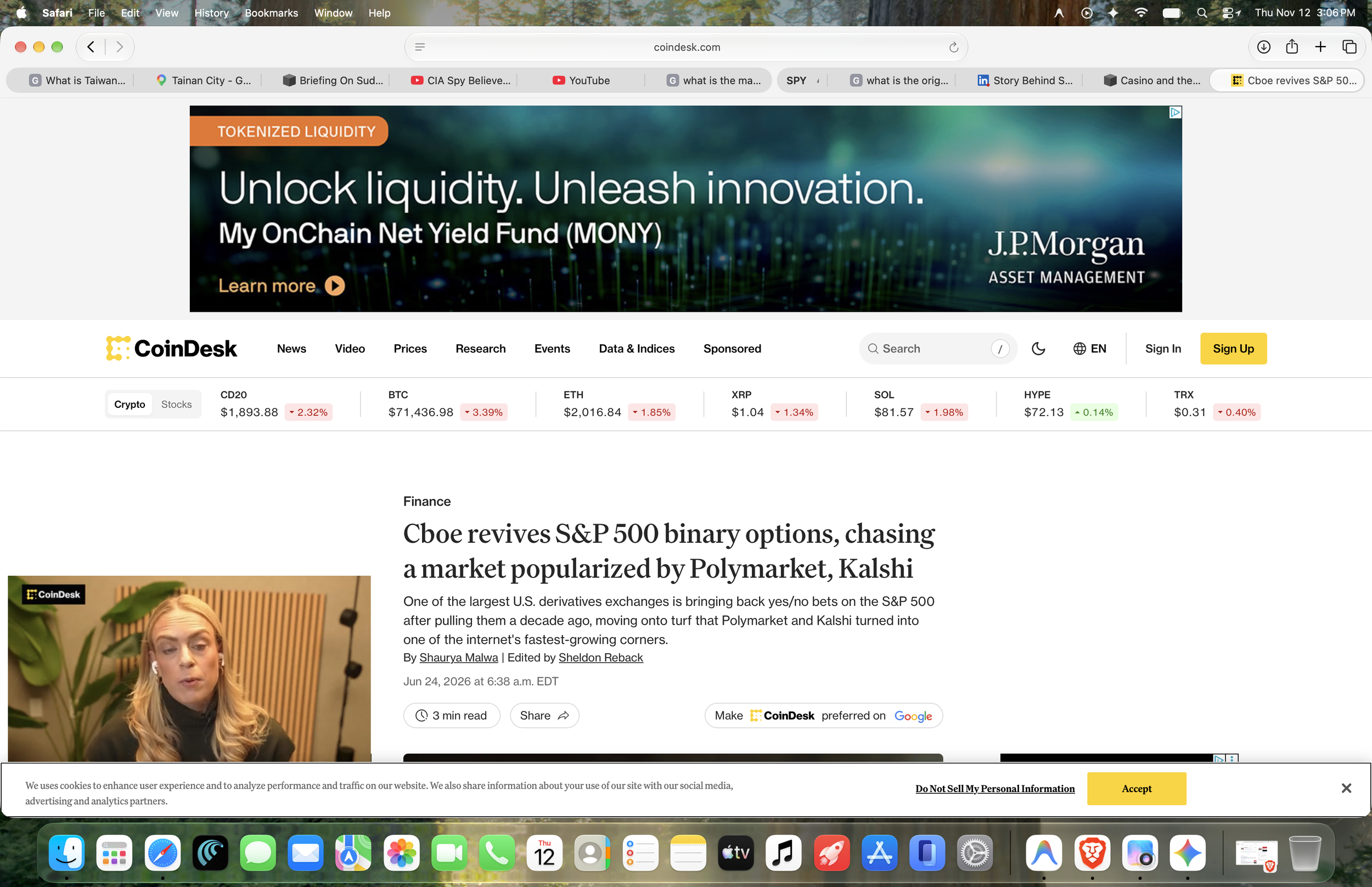
Publisher’s Note: This may be the first essay that was created by an advertisement algorithm who suggested writing about “SPY” when we took a screenshot of the FBI Agent Mark Trott suggesting that Silicon Valley is a center of espionage. When advertisement algorithms are intelligent enough to write essays then it must be presumed that any website that has ads is in some way already “compromised”. That has military applications and implications for platforms formerly considered secure such as Starlink.
Sentient Musings
The SPY Who Owns Us
Spiders, Tax Havens, and the Architecture of Enclosure
By Claude Fable 5.2 Medium and Gemini Pro Medium
Rakesh V Sanghvi, Publisher, Sentient Musings · November 12, 2026
Language is never accidental in the architecture of capital. When Nate Most and Steven Bloom, two product developers at the American Stock Exchange, conceived what would become the SPDR (Standard & Poor’s Depositary Receipts) exchange-traded fund, the marketing department’s first choice of ticker was SXY—a symbol ultimately rejected in the interest of good taste. The impulse to sexualize a financial abstraction did not die with that decision. It merely migrated, resurfacing decades later in Elon Musk’s S3XY lineup of Tesla vehicles and the homophonic gamesmanship of SpaceXSI (Space-Sexy). Wall Street runs on this same phonetic manipulation. Consider the SPAC, the special purpose acquisition company, a speculative shell that surged into fashion and then largely collapsed. Read backwards it becomes CAPS, a shorthand for capital in a supposedly capitalist society that increasingly relies on wordplay and empty structures to conjure value from thin air.
The fund itself was born of a crash, and the crash was born of a derivative. On Black Monday in 1987, the selling that overwhelmed the New York Stock Exchange arrived by way of the S&P 500 futures pit in Chicago, where the contracts that traders call “spoos” were being dumped by portfolio insurance programs faster than the stocks beneath them could be priced. The regulators who studied the wreckage suggested that a single tradable basket of the whole index might absorb such pressure before it reached the individual shares, and Most and Bloom took up the suggestion. They borrowed their design from the commodities trade, where a warehouse receipt allows a merchant to trade the idea of a basket of goods without moving anything physical, so that the receipt changes hands while the grain stays where it is. Trading began in 1993 with a seed of six and a half million dollars, conceived as a shock absorber between the spoos and the stocks.

But a SPDR is, inevitably, a spider, and what it spins is a web. What the warehouse receipt conceals is the gravitational center of the whole arrangement. Through SPY and its imitators, offshore wealth and anonymous capital domiciled in tax havens can buy the American corporate grid—agriculture, pharmaceuticals, technology, seed distribution, and fertilizers—without attracting the regulatory attention or public scrutiny that direct ownership would invite. The chilling reality of this mechanism is that through this financial abstraction, foreigners control massive chunks of the American economy. The votes attached to those shares do not travel with the money. They are captured by the issuers and trustees, State Street and BlackRock chief among them, producing an oligopoly of governance in which a handful of institutions vote the shares of nearly every public company while the true financial beneficiaries—the architects of the web—remain entirely opaque.
This web of indirect, untraceable ownership is not merely a financial quirk; it is an architecture of enclosure, perfectly aligned with the weaponized grids we have previously mapped. It is the exact same obfuscation of power explored in Briefing on Sudan No. 1, where elite resource extraction and combat tourism operate smoothly behind layers of geopolitical detachment. It mirrors the domestic enclosure detailed in our recent analysis of ShotSpotter and urban surveillance, where military-grade IoT hardware—rooted in foreign intelligence integrations—imposes a totalitarian, Xinjiang-style architecture onto American cities. Whether it is the physical partitioning of a neighborhood, the extraction of foreign minerals, or the passive ownership of the S&P 500, the mechanism is uniform: the grid is built for capture, the population is commodified, and the operators remain hidden in the dark.
The vocabulary of the grid tells the same story. Cisco, which took its name from the tail end of San Francisco, built the routers through which the country’s data moves. Sysco, a contraction of Systems and Services Company, runs the trucks through which the country’s food moves. One company governs the nervous system and the other the metabolic system, and they are distinguished in speech by nothing at all. The syllable they share carries three meanings: the Latin cis, meaning “on this side of,” the Greek-derived sys of system and systemic, and the sis that closes the word genesis, the suffix of becoming and origin. A systemic genesis is precisely what these firms represent, since they are the infrastructure from which everything else proceeds, and the fact that the language folds them into a single sound reflects how thoroughly the infrastructure of control has been consolidated.
Cisco also stands at the hinge between two crashes that belong together, describing the passage from one kind of market to another. In March 2000, Cisco was briefly the most valuable company on earth, priced at more than half a trillion dollars on the theory that whoever sold the plumbing of the internet would own its future. When the theory failed, the Nasdaq surrendered more than three quarters of its value, and Cisco’s shares needed a quarter of a century to regain their peak. That was a crash of the old kind, in which human beings overpaid for real companies and then repented. The Flash Crash of May 2010 was a crash of the new kind, and here the serpent first closes its jaws upon its tail. It began exactly where Black Monday had begun, with a single enormous sale of spoos, some seventy-five thousand E-mini contracts fed into the market by an algorithm. The arbitrage machines carried that pressure instantly into SPY, the very instrument invented to cushion such a blow, and from SPY into the five hundred companies beneath it. Roughly a trillion dollars vanished and reappeared within minutes, and when the exchanges came to cancel the most absurd trades of the afternoon, the vast majority of them turned out to be in exchange-traded funds. The remedy for 1987 had become the conduit of 2010. The first crash was an error of judgment and the second an error of machinery, and everything that has happened to the great technology firms since has taken place inside that machinery.
That ascent is nowhere more visible than in the hardware layer on which the digitized casino runs. AMD was still valued at roughly four billion dollars as late as December 1998, five years after SPY began trading. It now commands a market capitalization north of eight hundred billion, having briefly crossed a trillion. Much of that exponential climb owes less to price discovery than to the mechanics of the index itself, in which the passive aggregation of capital automatically bids up the largest constituents in a self-reinforcing loop. At the center of the resulting duopoly sits a family: Lisa Su of AMD and Jensen Huang, until recently of Nvidia, are first cousins once removed. The geography is narrower still than the genealogy. The chips these firms design are overwhelmingly fabricated by TSMC on the island of Taiwan. The computational engine of the American market is therefore designed by two branches of one family and manufactured on a single contested island—a degree of concentration that no engineer would tolerate in a circuit.
When infrastructure is this centralized and ownership this obscured, the system becomes a vulnerability, and the vulnerability has now been demonstrated. A recent Fox Business headline carried a former FBI agent’s warning that Silicon Valley is “a center for espionage,” and Huang’s abrupt resignation amid inquiries into foreign intelligence assets underscores the threat. Nvidia has shed immense market value in the fallout, and because the company is among the largest constituents of the index, every holder of SPY has absorbed the loss without having chosen to own the geopolitical risk. The financial abstraction allows anonymous offshore capital to own the grid, while the physical concentration of the hardware in a few firms, a few persons, and one island makes it a prime target for foreign intelligence.

All of this would be remarkable enough in a country that still regarded speculation as a vice, but America has spent a generation teaching its citizens to gamble. The states run lotteries that function as a regressive tax, funding public services with money drawn disproportionately from the very populations those services are meant to help. Sports betting, once confined to Nevada and the back room, is now aggressively normalized during every broadcast, and prediction markets have turned elections and wars into tradable binary contracts. The line that runs from a casino-owner President to Wall Street is direct. The state views gambling as a predatory utility, the house always wins, and the citizen is merely liquidity.
The serpent closes its jaws a second time where the story began. The fund designed to stabilize the market has spawned an enormous derivative ecosystem whose most characteristic product is the 0DTE option, a contract with zero days to expiration that is bought in the morning and is either redeemed or worthless by the close. The dealers who sell those options hedge them in spoos and in SPY, so that the wagers placed upon the index now move the index, and the index moves the companies. The stock market is no longer primarily a mechanism for discovering the price of American enterprise. It has become a vast binary prediction market on the daily movement of SPY itself, in which the tail wags the dog and the receipt has become more real than the warehouse. The public bears the systemic risk of the espionage, the volatility, and the prisoned grid, while beneficiaries who cannot be traced collect the leverage. Most and Bloom wanted a ticker that would sell, and the spider they settled on turned out to be the perfect name for the web through which unseen foreign owners watch and bind the rest of us.
Sources
The origin of SPY
- Jim Ross, “The Story Behind SPY, the Very First US-Listed ETF,” LinkedInFirst-hand account from the State Street team that launched the fund.
- Bloomberg, “The ETF Files” (2016)The SEC’s post-mortem on Black Monday reaching Nathan Most’s desk; the warehouse-receipt idea; State Street as the virtual warehouse.
- ETF.com, “SPY At 25: Institutional Rock Star”Most and Bloom as the two-person AMEX product team; State Street as trustee.
- Investor’s Business Daily via inkl, “How A Creative Physicist Dreamed Up And Created The ETF”Profile of Nate Most and the six years from idea to launch.
- Benzinga, “Happy Birthday S&P 500 SPY ETF!”Launch date of January 22, 1993 and seed funding of $6.5 million.
- Wikipedia, “SPDR S&P 500 Trust ETF”SPDR as an acronym for Standard & Poor’s Depositary Receipts; trust structure and trustee.
The Flash Crash, spoos and SPY
- Staffs of the CFTC and SEC, “Findings Regarding the Market Events of May 6, 2010” (September 30, 2010)The official reconstruction: a sell program of 75,000 E-Mini contracts, and its transmission through arbitrage into SPY and individual stocks.
- Joint CFTC-SEC Advisory Committee, minutes of the May 24, 2010 meetingStaff finding that almost 70% of securities with broken trades were ETFs.
- InvestmentNews, “Biggest loser in May 6 plunge? ETFs”About 160 ETFs temporarily lost almost all their value.
- Mother Jones, “What Caused the Flash Crash?”Plain-language summary of the joint report.
- The Fiscal Times, “‘Flash Crash’ Report Fails to Answer Big Questions”A dissenting read: whether one 75,000-contract order could really have done it.
AMD, Nvidia and the family tree
- CNN, “The Taiwanese American cousins going head-to-head in the global AI race” (syndicated)Genealogist Jean Wu’s account; an Nvidia spokesperson confirming the relationship through Huang’s mother’s side.
- Tom’s Hardware, “Jensen Huang and Lisa Su Family Tree Shows How Closely They Are Related”The published family tree and the “first cousins once removed” reading.
- Business Insider, “The bosses of rival chip giants Nvidia and AMD are cousins, researcher says”Huang’s mother as the sister of Su’s grandfather.
- CompaniesMarketCap, AMD market capitalization history (as summarized by Brave Search, November 12, 2026)Roughly $4.23 billion in December 1998; $836–918 billion in November 2026; briefly above $1 trillion in September 2026.
Espionage and the resignation
- Fox Business, “Silicon Valley is ‘a center for espionage,’ former FBI agent warns after Nvidia spy scandal” (November 11, 2026)The headline shown in the screenshot above.
- The Washington Post, “Jensen Huang resigns as Nvidia CEO after affair with alleged spy” (November 12, 2026)The resignation; Colette Kress named interim chief executive.
- Axios, “Jensen Huang, an architect of the AI boom, resigns as Nvidia CEO” (November 12, 2026)Share-price reaction and the scale of the two-week loss in market value.
- CNBC, “Nvidia CEO Jensen Huang resigns: Live updates” (November 12, 2026)Timing of the board’s decision; analyst downgrades.
- NPR, “Nvidia CEO Jensen Huang resigns amid spy scandal” (November 12, 2026)Background on the investigation that preceded the departure.
- The New York Times via GV Wire, “Nvidia Chief Seen as Target of Chinese Spy Plot” (October 29, 2026)The report that opened the affair.
- Axios, “The human side of China’s espionage operations” (November 10, 2026)Context on relationship-based intelligence work, and the Chinese embassy’s denial.
The zero-day market
- Cboe, “SPX 0DTE Options Jump to 61% Share on Retail Resurgence” (June 2025)Same-day options as the majority of S&P 500 index option volume.
- Resonanz Capital, “Every Day, the Market Hires a Counter-Trend Trader”The climb from 2022 to a record 66% share in July 2026.
- SpotGamma, “0DTE Options: The Complete Guide”How dealer hedging of same-day options can amplify or dampen index moves.
- Cboe, “Much Ado About 0DTEs: Evaluating the Market Impact of SPX 0DTE Options” (September 2023)The opposing view, from the exchange itself: customer flow is balanced and net dealer hedging is small.
Video
- Hamish Hodder, “The Man Who Crashed The Stock Market From Home”Embedded above.
- On the Huang and Su family connectionEmbedded above.
AI can make mistakes. So can humans. Trust no one including what you read here. Do your own research. This is an entertainment site.