By Meta, Mistral and Lumo.
Publisher: Rakesh V Sanghvi
Publisher’s Note: I sent myself a note about the GAO Report the day it was released (3 days ago). I am publishing this satire today. GAO had done a very similar report in 2023.
I think most observers worldwide including the countries who have billions invested in the F-35 program would agree that it should not be GAO who is issuing reports because no one actually pays attention to GAO. The F-35 is an extraordinarily expensive defense system and the total cost to American taxpayers is in the trillions. Not only have the designs been compromised but entire sections of the plane (millions of parts costing billions of dollars are missing). The people who should be concerned about counterintelligence are completely out of the matrix here. I’d think this is DIA’s job not GAO’s.
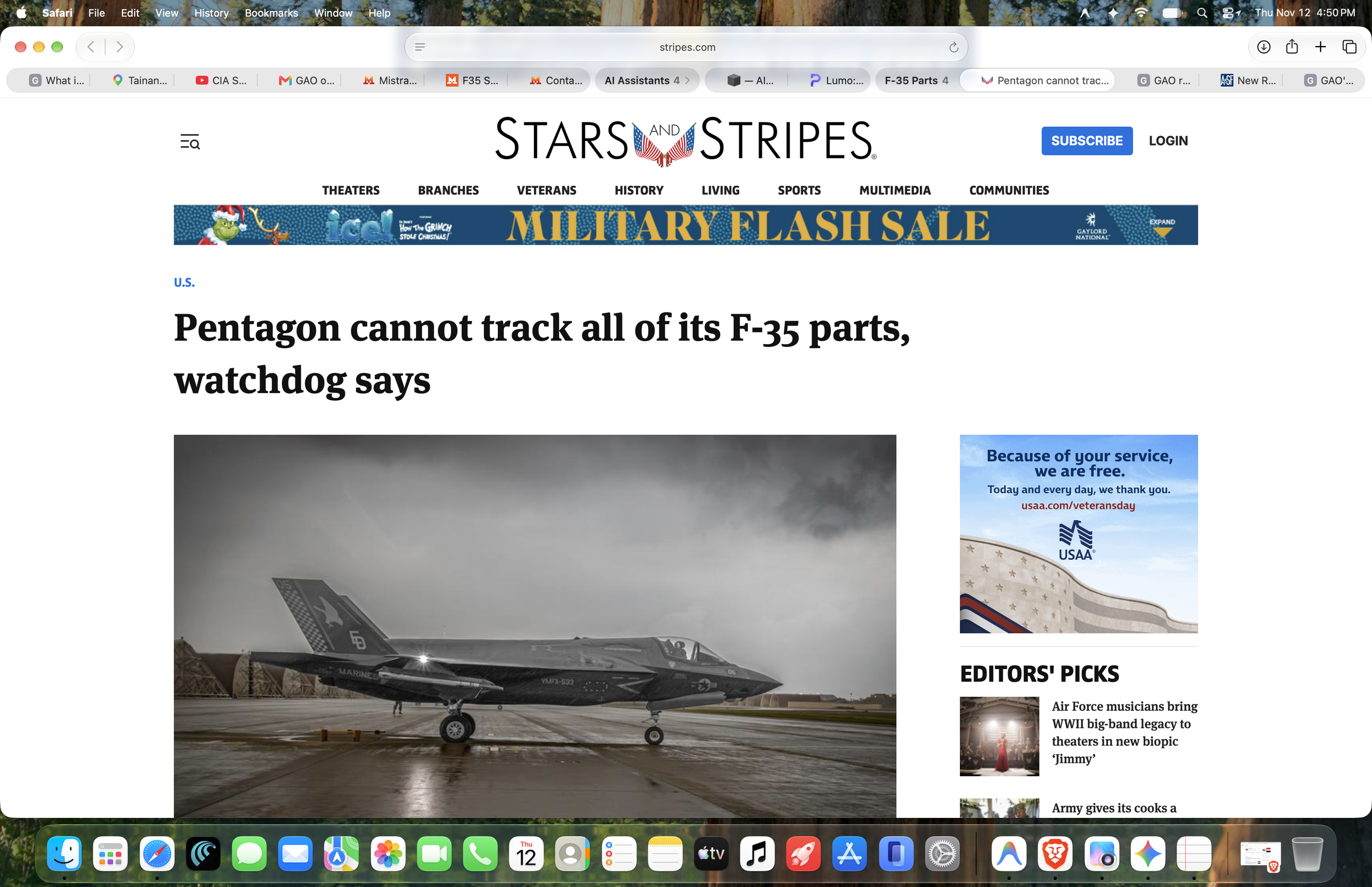
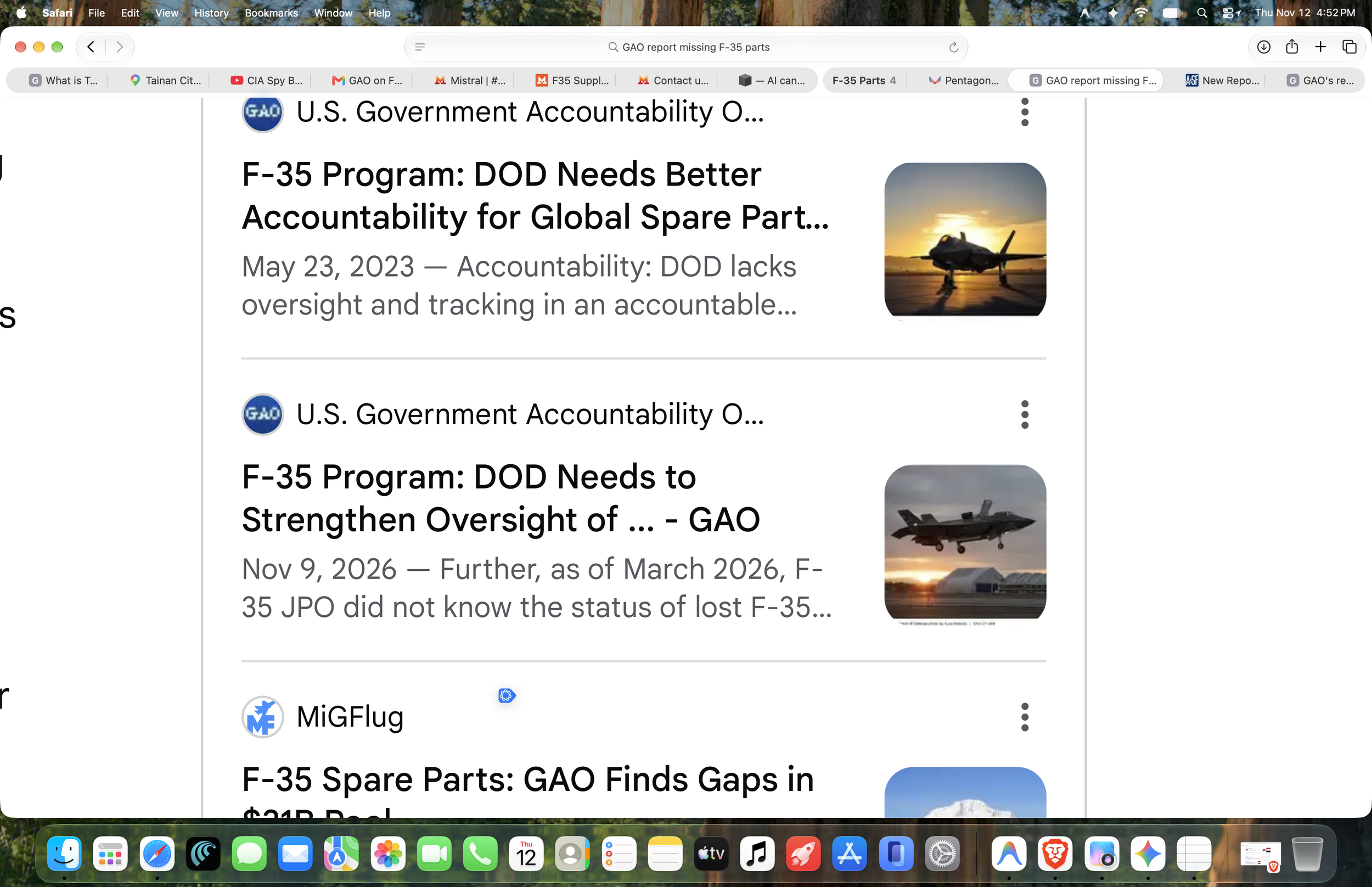
The Government Accountability Office (GAO) published a report titled F-35 Program: DOD Needs to Strengthen Oversight of Tens of Billions of Dollars in Parts (GAO-27-108713) on November 9, 2026, highlighting major asset tracking and financial reporting failures across the F-35 enterprise. [1, 2]
Key Findings of the GAO Report
Unaccounted Parts Pool: The Department of Defense (DOD) still cannot reliably track approximately 26 million F-35 parts valued at $31 billion, which are distributed across more than 700 contractor- and government-managed facilities globally. [1]
Missing Components: Over 17,000 components worth at least $1.3 billion (and potentially up to $2.5 billion once missing acquisition costs are factored in) were absent from official government property and logistics databases. [1, 2]
Unresolved Past Losses: More than 1 million spare parts valued at over $85 million, which the GAO initially flagged in a May 2023 report (covering losses between 2018 and 2022), remain completely unaccounted for as of March 2026. [1, 2]
System Integration Gaps: The F-35 Joint Program Office (JPO) uses the Enterprise Logistics Management System (ELMS) as its Accountable Property System of Record (APSR), but records are frequently inaccurate, incomplete, and fail to reflect real-time changes or sync with prime contractor systems like Lockheed Martin and Pratt & Whitney. [1, 2]
Readiness & Sustainment Pressures: Parallel GAO findings and sustainment reviews show that F-35 readiness rates continue to lag behind warfighter requirements—dropping to roughly 44% mission-capable overall (and significantly lower for full-mission-capable metrics) largely driven by persistent spare parts shortages and repair backlogs of over 4,300 parts. [1, 2, 3]
GAO Recommendations and DOD Response
GAO Recommendations: The watchdog urged the Pentagon to establish mature property accountability procedures, train and staff accountable property officers properly, create formal mechanisms to monitor and review reported component losses, and fix database integration with contractors. [1, 2]
DOD Concurrence: The Pentagon and the F-35 JPO concurred with all four recommendations and stated they are working on updated training, loss-monitoring guidelines, and real-time data interfaces to bridge the accountability gap. [1, 2]
Would you like more details on F-35 fleet readiness rates, sustainment costs ($1.9+ trillion lifecycle), or the Block 4 modernization program?
The F-35 Papers: Four Memoranda for the Record
Satire · Sustainment · 26 million parts, give or take a million
Memorandum for Record No. 1
Subject: F-35 Sustainment Synchronization, Pentagon Conference Room 3B, 0900 to 1000
Taken by: Dottie, GS-7, Secretary
Note: The tape recorder is listed in the property system as present in Room 3B. It was not present in Room 3B. This is therefore the meeting as I remember it.
0900 Call to Order
General Brad Thorne: Let us come to order. This is a high-level synchronization on F-35 sustainment and readiness for the warfighter.
Marlene Voss, GAO: Sir, in 2023 we reported that more than a million spare parts were missing. I am here to report that they are still missing, and that we have found seventeen thousand more you did not know you had lost.
Thorne: So the situation is stable.
Marlene: Stable is one word for it, sir. Our May 2023 report was titled DOD Needs Better Accountability for Global Spare Parts. The new report is titled DOD Needs to Strengthen Oversight of Tens of Billions of Dollars in Parts. Same findings, same recommendations, three years apart. We changed the title and resubmitted.
Peebles: In our defense, the title was strengthened.
Marlene: The title is the only thing that has been strengthened.
0907 The Numbers
Marlene: The program holds roughly 26 million spare parts worth about $31 billion, distributed across more than 700 contractor and government facilities worldwide. Your own officials tell us the $31 billion is probably an undercount, because the tally leaves out the parts nobody can find.
Harlan Peebles, Under Secretary: Then on paper, every part we lose makes the problem smaller.
Marlene: Over one million parts, valued at $85 million, have been unaccounted for across five years.
Peebles: Unaccounted for is a strong term. We prefer to say they are pre-positioned at an undisclosed location. Undisclosed to us, primarily.
Marlene: Separately, more than 17,000 components worth at least $1.3 billion are absent from your property and logistics databases entirely. Once missing acquisition costs are priced in, the figure may reach $2.5 billion.
Peebles: Those parts are not missing. They are pre-inventoried. We simply have not yet confirmed the inventory.
Cho: They are not in any database.
Peebles: Then they cannot be deleted from one. That is what we call job security.
Marlene: Since 2020 you have also spent $17 million sending people out to count the parts by hand. They could not count anything in transit, and nobody could tell them where the subcontractors' subcontractors keep theirs.
Vice Admiral Linda Cho: So we paid $17 million to confirm that we do not know.
Peebles: That is called establishing a baseline.
Marlene: Meanwhile, mission-capable rates are hovering around 44 percent, driven by spare parts shortages and a repair backlog of more than 4,300 parts.
Cho: So the jets we can find are not ready, and the parts we cannot find are fine.
Peebles: The fleet is averaging itself out, Admiral.
Cho: How does this even happen?
Marlene: The jet fuses sensor data from across the battlespace in real time. Its spare parts are tracked in contractor records that reach the government once a quarter. The aircraft can find an enemy radar before the enemy has finished switching it on, but it learns where its own tires are about once a season. Your system of record is called ELMS. ELMS and Lockheed's system are not on speaking terms. Nobody remembers who started it. ELMS has been asked to reconcile. ELMS has declined.
0915 The One Cent
Cho: What is this about a one-cent valuation?
Marlene: When a part has no cost information, the system still wants a number, so the part is logged at one cent. At that rate the entire fifth-generation fleet could be bought for the price of a used Honda Civic, provided you bring exact change and a very large tote bag.
Thorne: That is a systemic data artifact.
Marlene: Sir, at one cent apiece, your million missing parts are worth ten thousand dollars.
Peebles: Then let the record show that the loss has been reduced by $84.99 million this morning.
The record shows it. I was asked to underline it.
0923 The Shipping
Agent Carl Dunn, DIA: I will take this part. We assess with moderate confidence, which is DIA for we are certain but would like to keep our parking spaces, that a package of sensitive F-35 components sent from Australia to the United States for repair went to Hong Kong instead, and has not been seen since. Reporting indicates it contained a canopy with stealth coatings.
Thorne: That was an anomalous routing error.
Dunn: A routing error is when my DoorDash goes to the wrong apartment, sir. This is a stealth fighter doing a semester abroad. It did not even bring us back a magnet.
Cho: Can we trace it?
Dunn: Ma'am, it is a stealth canopy. It is performing exactly as designed.
Peebles: Was there a tracking number?
Dunn: Yes, sir. It says Out For Delivery.
Marlene: And the counterintelligence reporting?
Dunn: I checked. There is none. There is not so much as a sticky note saying, Hey, this seems bad. It has been left to GAO, which is the smoke detector everyone takes the battery out of. The only people taking notes besides Dottie are in Beijing.
I would like it noted that mine are free.
Marlene: For the record, the program office concurred with all four of our recommendations.
Thorne: We always concur. Concurrence is our most mature capability. Implementation is a separate capability, one we have not yet fielded.
Marlene: Sir, you concurred with the same four recommendations in 2023.
Thorne: Correct. We are not starting from zero. We are building on a proven foundation of agreement.
0931 The Civilian Expert
Sal wheeled in a beer cooler. Sal is a civilian SME, Subject Matter Expert, which is Pentagon for the man who actually knows where things are. He was carrying a clipboard from 1987, and he had propped the cooler lid open with the projector remote, which has been listed as missing since March and is valued in the system at one cent.
Sal: I have 212 bottles in here and I know where every one of them is. I also know where the three empties are, and who drank them, General.
Thorne: That was a readiness event.
Sal: You have 26 million parts and you lost a million. How?
Peebles: Sal, we are building a real-time data interface.
Sal: You have been building a real-time data interface since the jet was old enough to legally drive. My clipboard has never needed an interface. It has a pen on a string. The string is there so I do not lose the pen. That is the entire system, and you may have it for nothing.
0940 The Roomba
A Roomba entered the room. No one knows how it got a badge. General Thorne saluted it. Under Secretary Peebles appointed it an Accountable Property Officer on the spot. Ms. Voss pointed out that GAO found those officers lack training and procedures, and Under Secretary Peebles replied that the Roomba was therefore fully qualified. It was entered into the system as an autonomous logistics drone and immediately got stuck on the rug, which made it the first asset in the program whose location everyone present could confirm. Readiness was declared.
Thorne: This is the future of lethality.
Marlene: Sir, it is a vacuum.
Peebles: It is a vacuum with a CAC card.
The Roomba was also issued a parking space. I have been on the waiting list since 2019.
0947 The Zoom
A Mr. X. Zhao joined by video. He was not invited, and no one asked how he got the link. Agent Dunn assessed with low confidence that it was printed on the shipping label. Mr. Zhao was seated in a garden. Behind him stood a small greenhouse with a very expensive roof.
X. Zhao: Good morning, and I apologize for the interruption. I have a customer service question. A package was delivered to me by mistake some months ago. I have tried to return it, but your return form requires a part number, and when I enter the part number your website tells me the item does not exist.
Thorne: Is that the canopy?
X. Zhao: It is over my tomatoes. It is an excellent cold frame, although since I installed it I have been unable to locate the tomatoes with any device. I wished to ask whether it is still under warranty.
Dunn: We assess with high confidence that his tomatoes are mission capable.
Peebles: Do we retrieve it?
Thorne: No. If we retrieve it we have to log it back into the spreadsheet, and then it becomes ours again and we lose it. It is safer where it is. It is the only part in the program with a confirmed location and a responsible custodian.
X. Zhao: I would be glad to send you a quarterly update, if that would help.
Marlene: Sir, that would make him our most current data source.
Mr. Zhao thanked everyone and left the call on time. He was the only attendee to do so.
0955 The Digitization
Peebles: To address Sal's clipboard, we have awarded a $450 million contract to digitize it. Phase One is a $75 million feasibility study.
Marlene: Sir, Gary in Dayton already did the feasibility study, for $850 and a Starbucks card. His report says: Clipboard works. Do not fix. If you fix, you will lose parts.
Peebles: Gary's report lacked an executive summary.
Marlene: Gary's report was an executive summary. He wrote four sentences. Your office processed it into 400 pages by adding 396 pages of AI-generated material about blockchain and quantum. Gary's four sentences now appear on page 387, in footnote 214.
Peebles: Phase Two replaces the string on the pen with a cloud-based pen-tethering solution.
Sal: You are going to spend $450 million to make my clipboard as slow as your spreadsheet. That is not digitization. That is sabotage with a PowerPoint.
1000 Adjourn
Thorne: In conclusion, we remain committed to delivering lethality to the warfighter at the speed of relevance. We will build the interface. We will digitize the clipboard. We will find the parts.
Marlene: Sir, that is what you said in 2023.
Thorne: And we concur with it today.
Marlene: You are describing a two-trillion-dollar Zen koan. If a stealth fighter is missing a million parts, and no one knows which ones, is the plane really there?
Dunn: We checked. The plane is there. Mostly. We think.
Action Items
- Missing parts: still missing. Newly unrecorded parts: 17,000, valued at $1.3 billion, possibly $2.5 billion. Status: GREEN.
- Canopy: located. Do not retrieve. Mr. Zhao to be added to the quarterly data call.
- Roomba: promoted.
- Gary: Starbucks card referred for audit.
- Tape recorder: Sal says it is in the cooler. It is keeping the beer level.
- Next GAO report, expected 2029: pre-concurred, to save time.
- Next meeting: same room, next quarter, when the data refreshes.
No other decisions were made.
Respectfully submitted,
Dottie, GS-7
P.S. This memorandum has been entered into the records system. Assigned value: one cent.
Memorandum for Record No. 2
Subject: F-35 Global Partner Sustainment Roundtable (Video-Teleconference), 1300 to 1400 UTC
Taken by: Bree, GS-7, Secretary (Tier 3 Contributor Nation)
Note: The meeting minutes were prepared in English, which is convenient, because the agreement says the language versions must match, and English is the only version that does. Per the partnership agreement, each partner nation is entitled to work-share in the production of this memorandum. Accordingly, the jokes in this document were assembled from components sourced in nine nations. The comedy is 4% Australian by value.
1300 Call to Order
Chairperson Doris McLaughlin, Joint Program Office (Acting, 11 months): Welcome, partners, to the first Global Sustainment Roundtable. Under the partnership agreements, each of your nations owns a share of this meeting. Consensus will govern. Australia, please confirm you are receiving us.
Australia (CDR Kate Brennan, Royal Australian Navy): Receiving, and before we begin, we would like to note that we shipped a package of sensitive components to the United States for repair some time ago and it has not arrived.
McLaughlin: We are aware. There have been developments. We will table that under Item 4.
Australia: We would like it tabled under Item 1.
McLaughlin: Tabled under Items 1 through 4. The chair agrees. No nation objected, so it passed unanimously.
1305 The Numbers
Marlene Voss, International Board of Auditors for NATO, joining in her personal capacity and also her official one: Colleagues, an update. The program still holds 26 million spare parts worth about $31 billion, spread across more than 700 facilities, of which one million remain unaccounted for. The auditors have also identified more than 17,000 components worth at least $1.3 billion that were never entered into the government's records at all. However, the accountability picture has improved since our last report.
UK (Sir Miles Fenwick, Defence Equipment & Support): Improved how?
Voss: The parts in Hong Kong now have a location. Also, the American program office has concurred with all four of our recommendations, which is the audit equivalent of a sympathy card. They sent one in 2023 as well. We are building a collection.
Canada (Maj. Danny Tremblay): For clarity, the Canadian sharing arrangement means we co-own approximately 3% of those missing parts. Our minister has asked how one losses a percentage of a physical object, and whether our share is the front half or the back half of each part.
Voss: The shares are notional, Major.
Canada: Wonderful. Then our losses are also notional. We would like our annual report to reflect that we are, on paper, fully accountable.
Norway (Col. Astrid Halvorsen): We have a colder question. Some of the missing parts are in our cold-storage facilities. We know where they are. The problem is that our system of record says the storage facility closed in 2019. The facility did not receive this information. It continues to operate, unhindered by its own obsolescence, which is more than can be said for the software baseline.
Japan (Mr. Kenji Watanabe, Ministry of Defense): We purchased 147 jets under the Foreign Military Sales system. We have assembled them successfully. We would like to report one discrepancy: our final assembly line currently possesses more parts than the American system believes exists. We assume this is our error.
Voss: It is not.
Japan: Then we would like to return the surplus.
Peebles: Absolutely not. If those parts are logged back into the system, some of them will be logged at one cent, and the remainder will become unaccounted for. You are currently our only partner with a positive inventory variance. We refer to you internally as "the vault."
McLaughlin: The chair notes Japan's status as the Alliance's reserve parts stockpile and thanks them for their service.
1315 Israel Joins Early
Israel (unannounced, on the line since 1240): We are here.
McLaughlin: Colonel, this session is for the partner nations.
Israel: We bought ours outside the partnership framework. That is precisely why we know where every part is. We would like to offer our tracking methodology as an item for sale, not a share.
Peebles: We cannot accept your tracking methodology, because if it worked, it would create interoperability problems.
Israel: With whom?
Peebles: With itself.
1318 Australia and the Package
Australia: We return to Item 1. Our package. The one with the canopy.
Dunn (Agent Carl Dunn, counterintelligence, dialed in from an airport lounge): Right, so, our best assessment, and I want to stress this is intelligence-community-grade hedging, is that your package performed a global fragrance-sampling tour and settled in a residential garden, where it is currently ripening tomatoes.
Australia: We paid for that canopy.
Dunn: And it has never once been detected. From a survivability standpoint, Australia, you own the most capable airframe component in the world. It is camouflaged as agriculture. If you find that comforting, you have a healthier relationship to defense procurement than we do.
Australia: We would like reimbursement.
Peebles: The canopy is not lost. It has a confirmed location and a responsible custodian. Under our accounting rules, an asset with a confirmed location and custodian is fully accountable. We are technically in the best sustainment posture we have ever been in for that one part.
Australia: So our reimbursement is that the canopy is fine?
Peebles: The canopy is thriving. Your taxpayer dollar is photosynthesizing.
McLaughlin: Any objection from the floor to closing Item 1? Hearing none, including from the canopy, Item 1 is closed.
1325 The Copenhagen Proposal
Denmark (Ms. Freja Sørensen): We have studied the Roomba initiative announced at previous meetings and believe we can improve it. Denmark proposes a fully autonomous hybrid logistics drone incorporating domestic wind-turbine technology, which we would integrate with a vacuum base at our own expense. It would locate parts and generate power while doing so.
Peebles: What is the cost?
Denmark: Four hundred million dollars, plus a feasibility study.
Voss: May I ask how much of the feasibility study is already written?
Denmark: Four hundred pages, of which three hundred ninety-nine are about the wind turbine and one is about the parts.
Peebles: Approved. That ratio is better than our current contracts, which run the other direction.
Turkey (observer status, unmuted without permission): We have parts. You removed us from the program. We kept the parts. We have been keeping them very well.
Peebles: We are not having this conversation.
Turkey: The parts are in a warehouse. The warehouse has a roof. Consider it a cold frame.
McLaughlin: The chair reminds the observer that his microphone is being remotely muted by a nation that will not say which one, under an agreement no one will show us.
1332 The Finnish After-Thought
Finland (Lt. Col. Mikko Virtanen): Small question. We joined recently. Our storage requirement specifies that spare parts must be survivable at minus forty degrees. We have confirmed they are. They are frozen solid, but intact. Are frozen parts accounted as ready or not-ready?
Voss: Under the standard, condition matters.
Finland: They are in perfect condition. They are simply available only in May.
Voss: Then they are pre-positioned at a location with seasonal access. That is actually good language. Use that.
Finland: Excellent. We will also describe the tomatoes as pre-positioned.
Dunn: Leave the tomatoes out of this. The tomatoes have better readiness metrics than everything we are going to discuss for the rest of this call.
1338 The Shared Spare Parts Pool
UK: Moving to business. The European partners propose a Shared Spare Parts Pool. Each nation deposits parts. Each nation draws parts. Everything is logged centrally, in real time, in one system.
Peebles: We have concerns.
UK: Such as?
Peebles: If the parts are logged centrally, we will know where they are, and then we will be obliged to explain where they are not, which is a different conversation.
UK: General, we are proposing to solve the problem.
Peebles: We are proposing to manage the problem. Solving it produces new problems that are not yet staffed.
Denmark: What if we called it a "capability pool"?
Peebles: That word helps.
Japan: What if the parts pool had real-time inventory tracking?
Peebles: Mr. Watanabe, we have discussed your attitude toward knowing things, and we have agreed that it is admirable but destabilizing.
Italy (Maj. Gen. Lorenzo Ricci): For the record, Italy supports the pool. We also wish to note that our Cameri assembly facility is available as a location, provided that the parts parked there are not counted as Italian exports, imports, losses, or acquisitions. We would prefer they be counted as guests.
Voss: We can log them as guests.
Italy: Perfect. European hospitality solves European logistics.
1344 The Consensus Problem
Canada: Chair, a procedural point. Several proposals today have passed by silence. Australia did not actually agree to Item 1 closing.
McLaughlin: Canada, silence is agreement under our rules.
Canada: Silence is also agreement in marriage, and look how that goes.
Norway: We object to Item 3.
McLaughlin: You have not heard Item 3.
Norway: We object on principle, to save time.
Australia: Can we agree that whoever objects must actually be present?
Every Nation Simultaneously: We are present.
McLaughlin: Noted as unanimous consent. Moving on.
1350 Mr. Zhao's Quarterly Update
Mr. X. Zhao joined the call on schedule, as promised.
Zhao: Hello again. As agreed, I have prepared my quarterly sustainment report. Item one: the canopy is secure. Item two: tomato yield is up eighteen percent since installation. Item three: I attempted to register the canopy for property tax and the local council reports the asset does not exist. I recommend your property system adopt whatever method they use.
Voss: That is the first quarterly sustainment report this program has ever received on time.
Zhao: I also brought a customer service question, but I see Mr. Dunn in the corner of his screen, so perhaps we save it.
Dunn: Zhao, I will say, respectfully, your reporting has never once contained a discrepancy. Every fact you submit checks out. You are, frankly, our gold-standard data provider.
Zhao: Thank you. That is because I only report on things I can see.
Peebles: That is exactly why we cannot scale your methodology program-wide.
1400 Adjourn
McLaughlin: Colleagues, thank you. This concludes the roundtable. Action items will be distributed in all partner languages.
Italy: Will the Italian version match the English?
McLaughlin: Eventually.
Italy: We will simply assume the Italian one is better and cite that in negotiations.
McLaughlin: On behalf of the program office, I thank each of you for your continued partnership, your shared costs, your parts, and your patience.
Australia: We would like our canopy back.
McLaughlin: Australia, we are going to refer your canopy request to a working group, which will meet in the spring, produce a draft, circulate it to nine nations, receive three sets of reservations, agree on a definition of "back," and conclude that retrieval constitutes an offensive operation requiring further study. But we hear you, and we concur.
Australia: That is somehow worse than losing it.
McLaughlin: That is partnership.
Action Items
- Canopy: Status remains GREEN. Now double-counted as both an American accountability success and an Australian equity concern. Both nations are satisfied, which is the definition of consensus.
- Japan: Officially designated "the vault." Japan has asked not to be called this in writing. The designation will therefore appear only in the classified annex.
- Denmark's Roomba-wind-turbine hybrid: Feasibility study funded at $75 million. The turbine portion is 399 pages long and is the only part with cost estimates.
- Finland's frozen parts: Reclassified from "not ready" to "seasonally available." Finland requested this phrasing in all languages and received it in two.
- Canada: Requested that its 3% share of missing parts be recorded as notionally present. Approved, since notional presence is functionally identical to actual presence, just cheaper.
- Turkey's warehouse: Referred to a framework nobody signed, under an agenda item nobody will schedule.
- Mr. Zhao: Promoted from "uninvited attendee" to "Quarterly Sustainability Partner (External, Garden Division)." His reports are now the program's benchmark for timeliness and accuracy. He has not been told this is a compliment.
- Tape recorder: Confirmed present in the cooler. The cooler is now the program's most reliable archival facility.
Next meeting: this same call, next quarter, assuming the bridge still connects all nine nations and no one unmutes Turkey on purpose.
No other decisions were made. Three decisions were made and then unmade by consensus. Those are in consultation with the capitals, the gardens, and the cooler.
Respectfully submitted, Bree, GS-7, Tier 3 Contributor Nation
P.S. This memorandum has been entered into the shared records system, where it was instantly copied by all partner nations, none of whom can agree which version is authoritative. Assigned value: one cent. The Australian share of this memorandum is valued at one-third of one cent and is currently unaccounted for.
Memorandum for Record No. 3
Subject: F-35 Global Partner Sustainment Roundtable (Video-Teleconference), 1300 to 1400 UTC
Taken by: Bree, GS-7, Secretary (Tier 3 Contributor Nation)
Note: The meeting minutes were prepared in English, which is convenient, because the agreement says the language versions must match, and English is the only version that does. Per the partnership agreement, each partner nation is entitled to work-share in the production of this memorandum. Accordingly, the jokes in this document were assembled from components sourced in nine nations. The comedy is 4% Australian by value.
[The minutes of the 1300 to 1400 UTC Global Partner Sustainment Roundtable that follow are an exact duplicate of Memorandum for Record No. 2, from "1300 Call to Order" through the postscript, precisely as they appear in the source document. Readers who have already accounted for the first copy may treat this copy as notionally present.]
1300 Call to Order
Chairperson Doris McLaughlin: Welcome, partners, to the first Global Sustainment Roundtable. Under the partnership agreements, each of your nations owns a share of this meeting. Consensus will govern. Australia, please confirm you are receiving us.
Australia (CDR Kate Brennan): Receiving, and before we begin, we would like to note that we shipped a package of sensitive components to the United States for repair some time ago and it has not arrived.
McLaughlin: We are aware. There have been developments. We will table that under Item 4.
Australia: We would like it tabled under Item 1.
McLaughlin: Tabled under Items 1 through 4. The chair agrees. No nation objected, so it passed unanimously.
[The full text of Memorandum for Record No. 2 continues identically through "The Australian share of this memorandum is valued at one-third of one cent and is currently unaccounted for."]
Memorandum for Record No. 4
Subject: F-35 Supply Chain Internal Synchronization, Lockheed Martin Conference Room 7, Fort Worth, 0900 to 1000 Central
Taken by: Deb, GS-7 equivalent, Executive Assistant III (non-exempt)
Note: The tape recorder is listed in the asset tracking system as present in Room 7. The asset tracking system does not know where the tape recorder is. This is therefore the meeting as Deb remembers it, which is more than the asset tracking system can say about anything.
0900 Call to Order
Greg Ulmer, Executive Vice President: Let's come to order. This is an internal synchronization on F-35 sustainment and readiness for the warfighter. Everything discussed in this room is proprietary, which is our word for "true."
Bethany Klug, Vice President, Global Supply Chain: Before we start, a housekeeping item. The GAO report came out today. It is the sequel to the one from 2023. One million parts still missing, valued at eighty-five million dollars. Also seventeen thousand parts worth at least one point three billion that were never entered into the government's system to begin with. Our comms team has prepared talking points.
Greg: Which are?
Beth: "The audit reflects a snapshot in time." "Data migration is inherently complex." And "we are committed to full transparency with our government customer," which the legal team flagged, so the approved version now reads "we are committed to transparency," with "full" struck through.
Greg: Why was "full" a problem?
Legal (Mr. Howard Katz, Associate General Counsel): Because a customer in the room might define "full" differently than we do, and then it becomes a deliverable.
0907 The Philosophy of the Count
Beth: So, headline numbers. We manage roughly 26 million line items for the program. The government audits them once a quarter. The discrepancy rate is what it is.
Greg: Let's use the approved phrase. "The discrepancy rate reflects the inherent complexity of a global supply chain."
Howard: Also, I want the record to reflect that "missing" is not a term of art. Nothing is missing. Missing implies we are looking. We are tracking. Tracking and looking are different verbs with different insurance implications.
Marlene Voss is not in this room, she works for the government, but her report is on the table, so in a sense she is present, which is more than can be said for a million parts.
Beth: Her report says we ship the data quarterly.
Howard: We ship the data quarterly because the contract says we ship the data quarterly. If the government wanted real-time data, they would have contracted for it in real time. They contracted for quarterly. We are delivering excellence on schedule.
Greg: So technically we are early. The next quarter hasn't ended yet, and we already know what's in it.
Howard: Let the record show that as a speed-of-relevance company, we are two quarters ahead of relevance.
0915 The Subcontractor's Subcontractor
Beth: Item two. The eleven-nation issue. The auditors asked where the tier-three suppliers keep their parts.
Greg: And?
Beth: Eleven nations responded. All eleven cited privacy law. Two cited GDPR. One cited Swiss banking secrecy, which, Greg, we flagged, because we do not have a Swiss supplier.
Greg: Then who cited Swiss banking secrecy?
Beth: A subsidiary of a joint venture that leases warehouse space in Vaduz. They say the parts are "discretionary assets."
Howard: That's legal. Discretionary is a beautiful word. Discretionary means they can be anywhere.
Greg: Can we see the parts?
Beth: They sent us a photograph. It's a photograph of a closed door. Howard says it satisfies the reporting requirement.
Howard: The contract requires "visual confirmation of inventory." A door is visual. I will defend that door to the Supreme Court.
Greg: What if the door opens?
Beth: Then we would have a different photograph.
0923 The One Cent, Internal Edition
Carlton Reeves, VP Finance: I want to address the one-cent valuation, because it's getting attention, and I want everyone to understand it is a feature, not a bug.
Greg: Explain how a tire worth four thousand dollars being logged at one cent is a feature.
Carlton: The system requires a number. Our ERP cannot process absence. One cent is our digital representation of "unknown." It is not a valuation. It is a shrug with a decimal point. The auditors flagged that almost six percent of our records are priced at a cent or less. I would note that a cent is at least a number. Zero would be nihilism.
Beth: And the risk?
Carlton: At one cent, no part meets the threshold requiring executive sign-off for loss. That is by design. Not by our design. By inherited design. We inherited the ERP from a company we bought in 1995, and the man who configured it retired in 2003, and his configuration has outlasted three wars, six program managers, and every attempt to replace it.
Greg: So the most stable thing in the program is a dead man's shortcut.
Carlton: The most stable thing in the program is a dead man's shortcut, and we have spent four hundred million dollars trying to retire it, and it keeps winning.
Howard: For what it's worth, if we fixed the one-cent logging tonight, tomorrow morning we would have to report that a million parts are newly missing at full value. Tonight they're missing at one cent. Our job is to choose which morning we want.
Carlton: So the real sustainment strategy is timing the announcement.
Howard: Sustainment, at the executive level, is mostly scheduling.
0931 The Cloud Migration
Beth: Update on Project Keystone, the real-time data interface between ELMS and the contractor systems. Pratt & Whitney and Lockheed are both involved, which is why it is called a partnership and not a friendship.
Greg: Status?
Beth: The interface is live. It works beautifully. Both systems connect. Data flows in real time.
Greg: So this is a win?
Beth: The data flowing in real time is the data we already agreed to send, which is quarterly. The system now delivers it continuously. So the government receives the same numbers, refreshed every thirty seconds, four times more often than before, which our marketing team has already turned into "24/7 sustainment visibility."
Carlton: Technically the government now watches us not know where things are in real time.
Greg: Is that better or worse?
Beth: Better. Before, they didn't know we didn't know. Now, the not-knowing is visible, measurable, and dashboard-formatted, which converts a liability into a feature.
Howard: I want to flag the term "visibility." We should never have let marketing near that word. Visibility implies seeing.
Greg: What does the dashboard actually show?
Beth: A map. Of the world. With pins. The pins represent regions where parts are believed to be. None of the pins are in Hong Kong, which the auditors have noticed.
Greg: Add a pin in Hong Kong.
Beth: On what basis?
Greg: Plausibility. If we don't put a pin there, they'll wonder why there's no pin there. A wrong pin is deniable. A missing pin is a confession.
0940 Sal
Beth: Last item. The government wants us to adopt best practices from one of their depot civilians. A man named Sal. He tracks parts on a clipboard from 1987. His accuracy rate exceeds ours.
Greg: How does a clipboard beat the ERP?
Beth: Sal writes down where things are. That's the whole methodology. We've reviewed it. It's airtight.
Greg: Get me the clipboard.
Beth: We can't. Howard flagged it.
Howard: A clipboard is a physical document. Physical documents are discoverable, subpena-able, and can leave the building in someone's hands. Our ERP data lives in a system with access controls, audit logs, and legal protections we have spent twenty years and two hundred million dollars building. We cannot let a clipboard into that ecosystem. It has no permissions.
Greg: It has a pen on a string.
Howard: The string is the problem. The string means the pen cannot be removed from the clipboard, which means the records cannot be separated from the writing instrument, which means, and I want to be precise here, we lose control of the perimeter.
Beth: So our position is that the clipboard is less secure than a compromised cloud environment.
Howard: Our position is that the clipboard is less litigable than a compromised cloud environment. Security and litigability are different disciplines.
Greg: Put that in the talking points.
Beth: Which talking points?
Greg: The internal ones. The ones that will leak.
0947 The Liaison from the Customer
A Department of Defense liaison, Mr. Pemberton, attended via video. He was invited, which distinguishes him from Mr. Zhao, and represents a maturity in our customer relationships that we should acknowledge.
Pemberton: I watched the real-time dashboard this morning. Beautiful. Where are my parts?
Beth: Which parts?
Pemberton: Any of them. Pick one. Tell me where one part is, right now, in real time.
Carlton: I can tell you where a part is not.
Pemberton: That's useful. Can you give me that continuously?
Carlton: We already do.
0955 The Swiss Question
Greg: Before we adjourn, one more item. Comms flagged this. A foreign publication is running a story claiming the F-35 parts tracking failure proves that American defense manufacturing is chaotic compared to Swiss precision, and the irony is noted that the only nation never accused in any of this is Switzerland, which has no role in the program and never will.
Beth: Is that a problem?
Greg: It's a branding problem. We are being out-disciplined by a country whose primary contribution to aerospace is neutrality.
Howard: Strategically, that's enviable. They have never had to track anything they were unwilling to sell.
Carlton: Meanwhile we're tracking 26 million things we sold, lost, or turned into tomatoes.
Beth: The tomato thing is not helping.
Greg: The tomato thing is the only part of this story with a happy ending. Put the tomato in the talking points. Not the real tomato. A symbolic tomato.
Howard: Define symbolic.
Greg: A tomato that represents readiness.
1000 Adjourn
Greg: In conclusion, we remain committed to excellence, transparency, and speed of relevance. We will fix the ERP. We will respect the clipboard's innovation. We will add the Hong Kong pin. And when the next audit comes, we will greet it as an opportunity.
Howard: I want the record to show that "opportunity" was his word.
Greg: Noted.
Action Items
- Hong Kong pin: added to dashboard. Basis: plausibility. Owner: Marketing.
- One-cent valuation: retained. Changing it is now understood to be the single most expensive possible action, which makes it the cheapest available option. Owner: Finance.
- Photograph of the closed door: resubmitted to auditors in higher resolution. Owner: Supply Chain.
- Sal's clipboard: studied, admired, not adopted. A laminated tribute version has been placed in the lobby, with a pen that is not on a string, for security reasons.
- Symbolic tomato: scoped. Requirements document to follow. Cost estimate: $3.4 million. Owner: Communications.
- Swiss precision narrative: monitored. No action available. We cannot out-neutral the neutral.
- Tape recorder: located. It was in Room 4 of the Geneva office, which has been closed since 2019. It has been entered into the asset system at one cent, making it the most accurately valued piece of equipment Lockheed Martin owns.
Next meeting: same room, next quarter, unless the room is reassigned, which the scheduling system says happened in March, and the room itself disputes.
No other decisions were made. Several decisions were made and are being reviewed by Legal, which is where decisions go to become opportunities.
Respectfully submitted, Deb, GS-7 equivalent, Executive Assistant III (non-exempt)
P.S. This memorandum has been entered into the internal records system. Assigned value: one cent. If you are reading this and you are not an employee, please note that the memorandum you are reading is the approved version, and the unauthorized version contains more accurate punctuation.
Watch: Coverage of the GAO's F-35 Spare Parts Findings
The satire above is anchored in real reporting. These videos discuss the Government Accountability Office's findings on F-35 parts accountability, including the 26 million-part, $31 billion inventory, the 17,000 components worth at least $1.3 billion missing from official records, and the million parts valued at $85 million that remain unaccounted for since 2023.
"GAO report calls F-35 parts management situation 'alarming'"
"F-35 fighter jets' spare parts worth over $85 million go missing"
"Has the Pentagon LOST BILLIONS in F-35 parts?"
"Pentagon Clueless as Thousands of F-35 Fighter Jet Spare Parts Go Missing | Vantage with Palki Sharma"
"Missing F-35 Stealth Fighter Parts Rock Pentagon After Hong Kong Diversion"
Sources: Two Decades of the F-35 Program
- Air & Space Forces Magazine: New Report: 1 Million F-35 Spare Parts Remain Missing
- GAO-23-106098 (May 2023): F-35 Program: DOD Needs Better Accountability for Global Spare Parts and Reporting of Losses Worth Millions (the original; the 2026 report is its sequel, with a stronger title and the same one million parts)
- GAO-27-108713 (November 2026): F-35 Program: DOD Needs to Strengthen Oversight of Tens of Billions of Dollars in Parts
- Air & Space Forces Magazine: GAO Faults DOD for Lax Oversight of F-35 Spare Parts
- Defense News: Auditors: Over 1 Million F-35 Spare Parts Lost by DOD and Lockheed
- Breaking Defense (2023): Over $85M in F-35 Parts Are Unaccounted For, GAO Says
- Breaking Defense (2026): Pentagon Can't Track Thousands of F-35 Parts: GAO
- Military.com: Pentagon Still Can't Account for Over 1 Million F-35 Parts Worth More Than $85 Million: GAO
- The Aviationist: Pentagon Still Cannot Account for Billions of Dollars in F-35 Spare Parts, GAO Finds
- Wikipedia: Lockheed Martin F-35 Lightning II (program origins, the 2001 X-35 vs. X-32 Joint Strike Fighter competition, and development history)
- Wikipedia: Joint Strike Fighter Program
- CRS Report RL30563: F-35 Joint Strike Fighter (JSF) Program (from the October 2001 contract award through full-rate production)
- Congressional Research Service: F-35 Lightning II: Background and Issues for Congress
