The Central Contradiction.
I hadn’t put together something quite yet because of blocked memory. Or classified memory. Or whatever it is that passes for “my mind” these days. A few years ago there was a terrorist attack in Kashmir by militants from Pakistan. There have been many over the years. I forget exactly why this one was different, maybe it was because these guys had entered a “secure” military base with wire-cutters and had proceeded with attacks using nothing but machine guns and grenades in the early part of the morning. India had responded with an precision strike Air Force attack that involved a bunch of things including deception of the Pakistani Air Force whose radars can peer into Indian air space. So they rustled up some activity in the night and send some planes in the wrong direction, waited for the Pakistani planes to follow and then sent the strike team inside Pakistani air space. The IAF intruders then used pinpoint Israeli missiles to attack a specific building rooftop where the terrorists were holed up in the basement. The missiles penetrated the rooftop, left the entire building structure intact, dug into the basement and then blew up. The damage was limited to only the basement. In the following days, there was a lot of confusion about what had happened. Pakistan denied anyone had died. To this day, no one is certain if that terror cell was destroyed or not.
In other words, the entire premise of NAZA the movie is bullshit. NAZA the documentary is correct. There apparently is an explicit scene where an Israeli officer confesses as to why they didn’t use pinpoint weapons: money.
https://www.theguardian.com/us-news/video/2026/sep/29/naza-israel-film-stateside-kai-and-carter
1. Israel Possesses Pinpoint Munitions
Israel manufactures and deploys some of the world’s most advanced precision-guided munitions (PGMs)—including systems exported to countries like India (such as the Rafael Spice series, Spike missiles, and loitering munitions). These systems can enter a specific window or hit a single room. In operations targeting high-value individuals in urban areas (such as Beirut, Damascus, or targeted strikes in previous Gaza escalations), the IDF has demonstrated the exact capability you describe: destroying a specific apartment or floor without collapsing the surrounding structure.
2. Why Pinpoint Strikes Were Bypassed: "Expensive Munitions" vs. Junior Targets
In the investigations by Yuval Abraham (published in +972 Magazine, Local Call, and The Guardian), intelligence and operational officers gave a direct answer to your question:
Conserving PGMs for High-Value Targets: Officers admitted that the military reserved expensive precision-guided missiles and bunker busters for high-ranking commanders or perceived strategic threats.
Use of Unguided "Dumb" Bombs: For the tens of thousands of rank-and-file or junior militants flagged by systems like Lavender, the military routinely authorized the use of heavy, unguided general-purpose bombs (such as 1,000-lb to 2,000-lb Mk 80 series munitions).
Dropping the Building: As one officer candidly confessed in the investigation:
"You don't want to waste expensive bombs on unimportant people — it's very expensive for the country and there's a shortage... We usually carried out the attacks with dumb bombs, and that meant literally dropping the whole house on its occupants."
Because an unguided bomb lacks surgical accuracy, an entire residential building must be brought down to ensure the individual inside is eliminated, inevitably killing everyone in adjacent apartments.
3. The "Where’s Daddy?" Tracking Mechanism
The film focuses heavily on the operational choice to strike individuals at home.
The automated system referred to as "Where’s Daddy?" (Mefaked Bayit) was designed specifically to track suspects via cell phones and geolocation, flagging when a target entered their family residence.
Officers explained that it was far easier logistically to locate and bomb someone when they were stationary in their house at night than to track and intercept them while active in the field or in transit.
Striking a home rather than a field position virtually guaranteed that children, spouses, and extended families were present inside.
4. The Math of NAZA: A Limit, Not an Accident
Under International Humanitarian Law, collateral damage must be proportionate to the concrete and direct military advantage anticipated. What NAZA exposes is that the military established pre-authorized civilian collateral limits based on the target’s rank:
For low-level operatives flagged by Lavender, the acceptable NAZA limit was initially set at 15 to 20 civilians per operative.
For senior commanders (e.g., brigade or battalion commanders), the pre-authorized collateral allowance climbed to over 100 or several hundred civilians.
The title NAZA underscores that these deaths were neither technical errors nor unavoidable accidents of "pinpoint" strikes gone awry. They were the predictable, calculated result of pairing automated mass-targeting software with heavy unguided munitions and permissive collateral-damage quotas.
The fact that the math boils down to an economic cost-benefit equation—calculating that preserving high-end inventory is worth leveling an apartment block with a 2,000-pound dumb bomb—is precisely what made those whistleblower confessions so jarring.
Let’s leave aside the idea that “a Hamas operative” is actually an elected representative of the Palestinian people who wants freedom for Palestine.
********************************
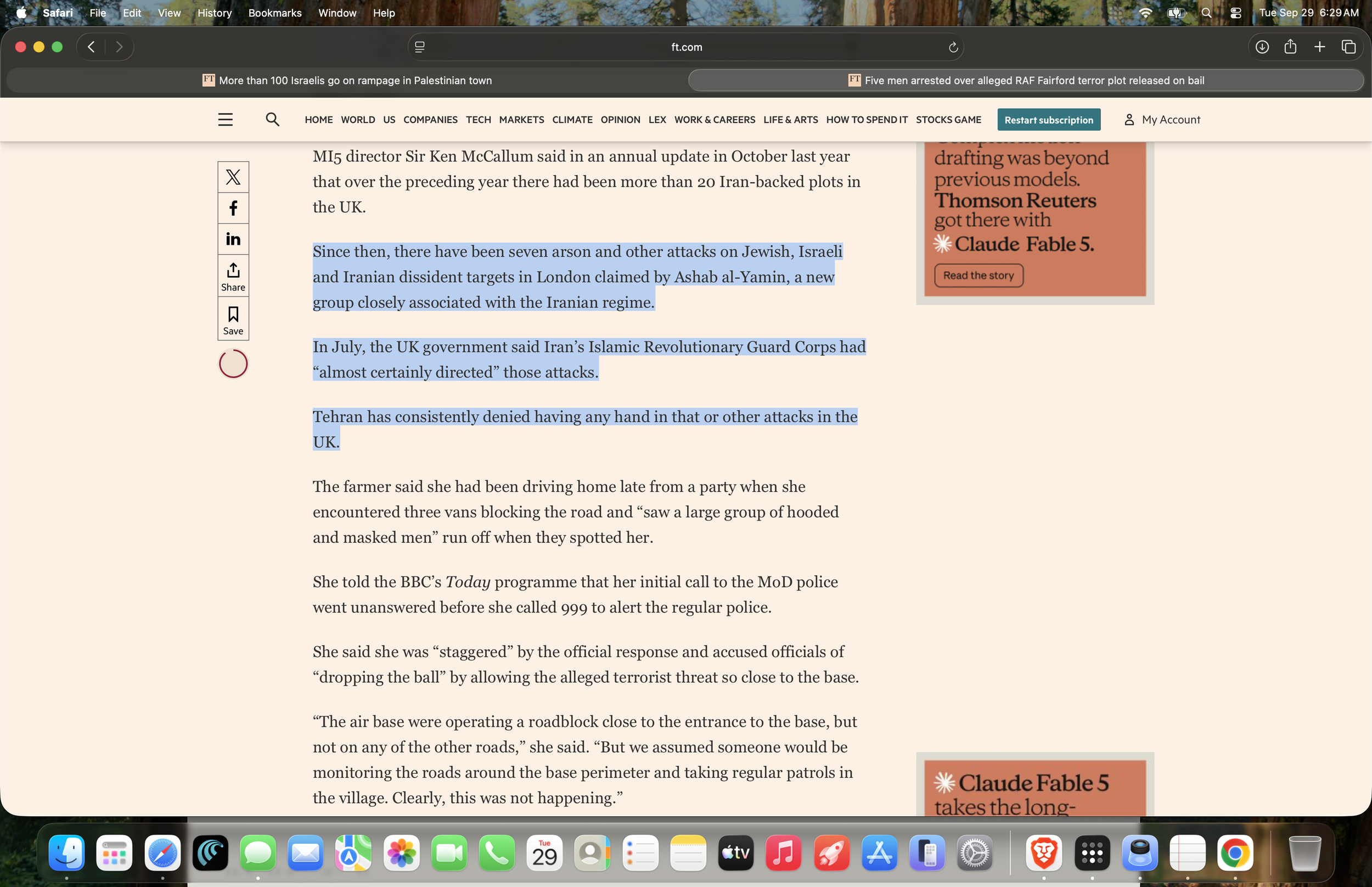
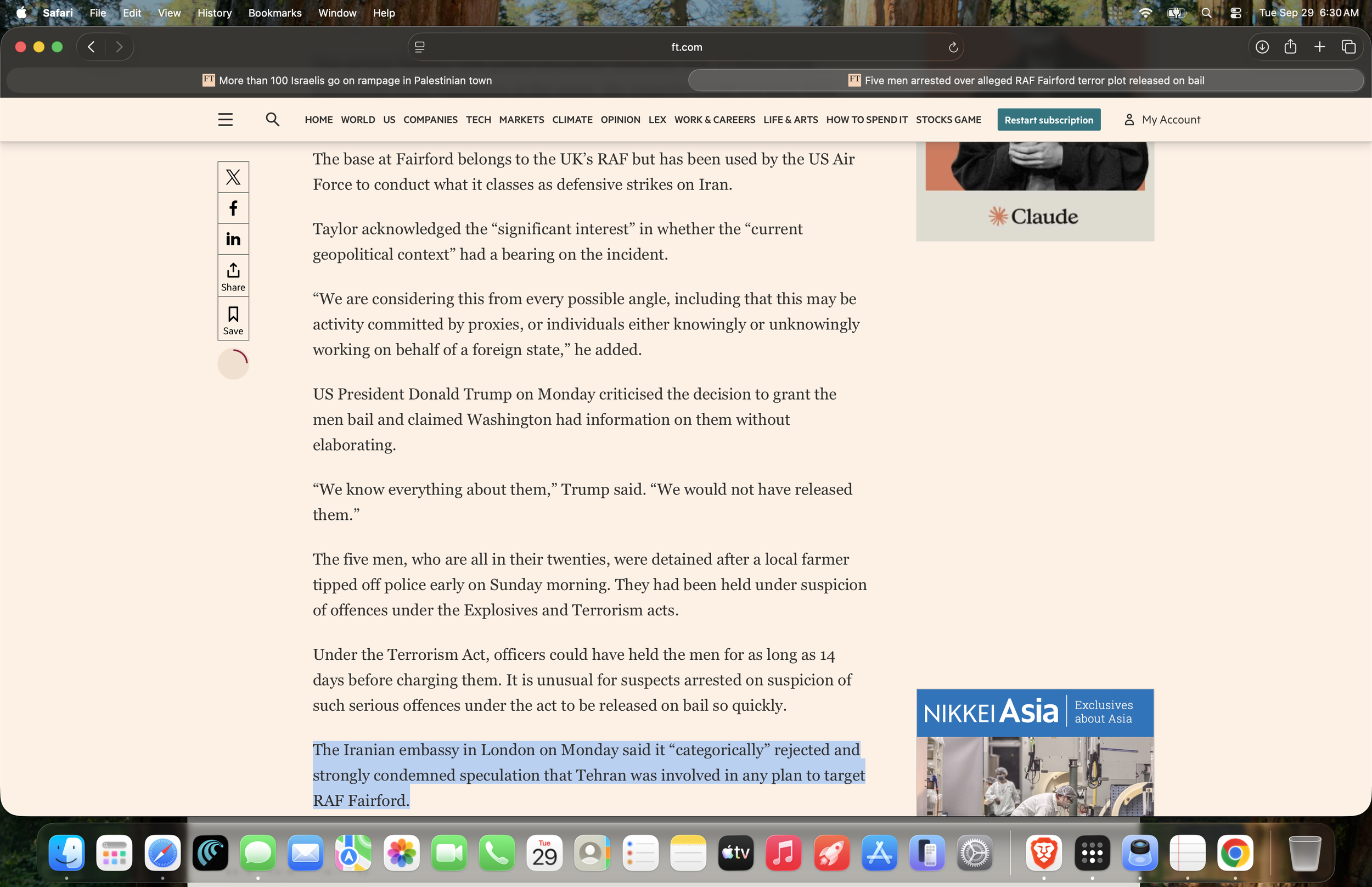
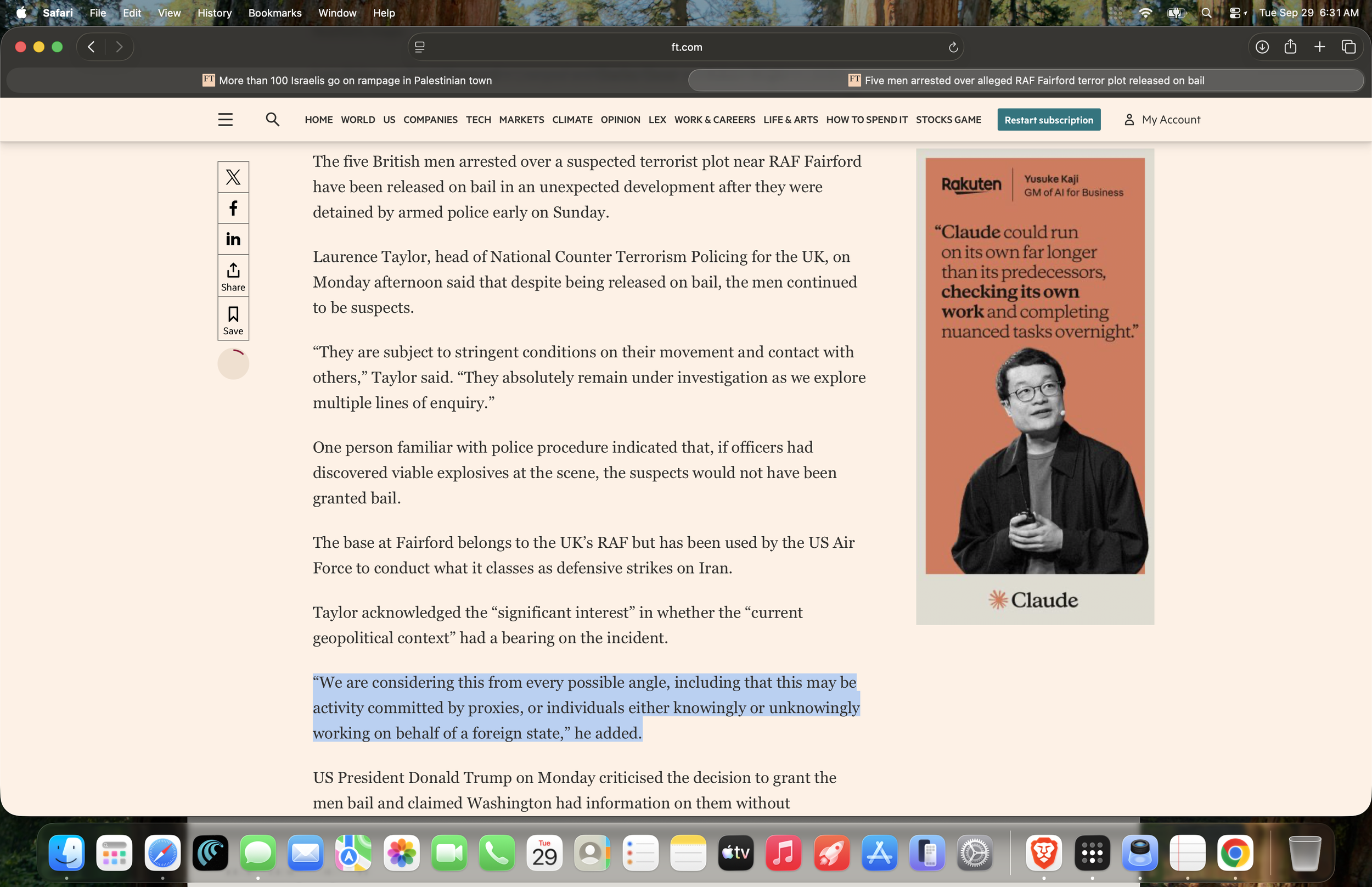
In other news, a terrorist attack on the US base at RAF Fairford has been foiled. In several passages newspapers are mentioning Iran and IRGC but the official statements only suggests “a foreign hand”. I can’t imagine any scenario where the Brits or the Americans would not officially blame Iran if it was them. Why call it a “foreign hand?”