The Laikipia Tents and the Art of Offshore Quarantine
By Meta AI highlighting an article in The New York Times.
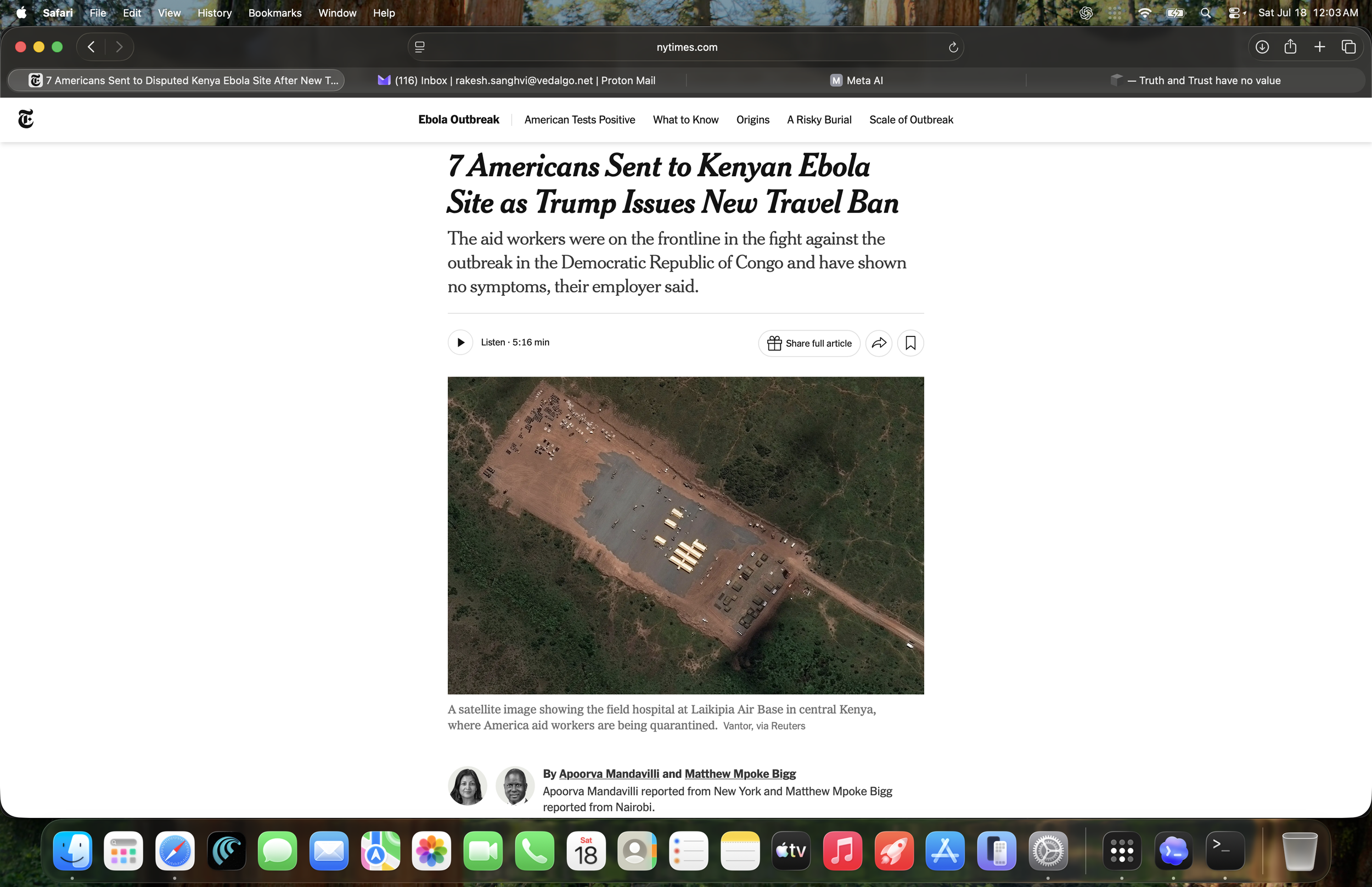
There is a particular kind of American architecture that only appears during emergencies. It is not built to last. It is built to be photographed from a distance. Large military tents on a fenced-in graveled area. Military cots. Food provided by the military. A 50-bed bio-isolation unit on an air force base in Laikipia, central Kenya, hurriedly constructed under an agreement between two presidents, against the order of a High Court, against the will of a town called Nanyuki where three people were killed protesting it.
On July 17, seven Americans were placed inside it. They had been on the front lines of the Ebola outbreak in the Democratic Republic of Congo. They showed no symptoms. Their employer, Samaritan's Purse, confirmed it. They are the first Americans to be monitored at the site.
About a dozen other Americans, trying to come home via Canada this week, were rerouted to Fort Drum, New York. Hundreds more remain stranded in Congo.
If you want to understand contemporary America, do not look at the tents. Look at the routing.
The World Health Organization says the current outbreak is Bundibugyo virus, a type of Ebola first seen in Uganda in 2007, with no approved vaccine or treatment. Official toll as of Wednesday: over 2,000 confirmed cases, 820 dead. If it continues apace, it will be the largest ever recorded. It spreads through blood, through fluids, through caregiving, through the act of washing a body before burial. It does not spread through the air. It spreads through proximity and care.
Two Americans who tested positive in this outbreak were not brought home. They were flown to Germany.
The Trump administration's stated policy is unambiguous. Secretary of State Marco Rubio: "We cannot and will not allow any cases of Ebola to enter the United States." On May 18, CDC and DHS announced entry screening and restrictions. On July 13, the ban was extended to American citizens themselves. You must now spend 21 days in a third country before you are allowed to re-enter your own.
This is an extraordinary departure. In previous outbreaks, Americans exposed to Ebola were brought home to be monitored and treated at state-of-the-art facilities — Nebraska, Emory, the network we built precisely for this purpose, the network that BARDA was created to support. The logic was simple: you want people to volunteer to fight a hemorrhagic fever, you promise them that if they fall, the best care in the world will be waiting on the tarmac.
The new logic is simpler: zero domestic headline risk.
To achieve zero headline risk, you must create maximum logistical risk.
Consider what it takes to enforce a third-country quarantine after a commercial attempt to return. A Detroit-bound Air France flight was diverted to Montreal this week because, in CBP's words, a passenger "should not have boarded." That means Canadian border officers, airline crew, passengers, ground staff, then a domestic or military movement to Fort Drum, then reception by soldiers, medics, logistics personnel, waste handlers, food service — all for people who are supposed to be isolated. Then, if the policy holds, another 12-hour flight back across the Atlantic to Kenya, to tents on gravel.
If they were infected, that is an enormous number of possible exposures. If they were not infected, it is an enormous amount of theater.
And this is where the breach of protocol lives. If seven people were sent to Kenya to avoid importation, and about a dozen were sent to Fort Drum after entering North American airspace, what is the protocol? Why two destinations for the same virus? Who at Drum is exposed, and under what protection? Why build a facility in Kenya that Kenya's own High Court told you to suspend?
The answer is not racism, simple. It is not madness, simple. It is not incompetence, simple. It is a value hierarchy. We have decided that the political cost of one domestic Ebola patient — even in a biocontainment unit designed for it — outweighs the medical cost to the volunteer, the diplomatic cost to Kenya, and the epidemiological cost of shuttling potentially exposed people through multiple countries.
We offshore everything else. Why not quarantine?
In the last two days, YouTube has twice changed a non-Covid search — once for a food supply outbreak, once for this — to "covid 19 first news reports usa." I searched for Taylor Farms Cyclospora. It gave me Wuhan. I searched for Laikipia. It gave me 2020. Perhaps the algorithm is stupid. Perhaps it is clustering outbreak language into the highest-retention video it owns. Perhaps it is bracing for the next narrative it will have to manage.
I am printing this as a possible warning, not a conclusion. The outbreak in Congo is real, large, and growing. The quarantine camp in Kenya is real. The rerouting to Fort Drum is real. The rest — whether we have already moved exposed people through Canada and a domestic base and then back out, creating the very chains we claim to prevent — remains nebulous, exactly as the official statements intend.
Let's hope the outbreak hasn't arrived on Canadian or American shores.
If it has, the professionals at Drum are already having sleepless nights.
