Things will change when Yale meets Princeton.
I have a vague sort of recollection writing that a few years ago. Or maybe it was a few months ago. When memory is shot, time becomes a fungible token. Within the neurons that store memory does it truly matter whether it was months or years ago? All that matters, for the present, in actuality is that it was in the past. That statement is true to the extent that the chronology is not important when reconstructing events in a logical order. If the past, present and future were simply cards, you could shuffle them in any order you like. Thankfully, that’s not how the world works. The deck of time is stacked in the correct order and the arrow of time is unidirectional.
Sometimes I run into some articles that puzzle me so I just leave them there on my phone, open, hoping that someone will notice and close them. Sort of saying, yeah, we see you kept this item open, we reviewed it, did a discreet background and the closing signifies it’s been taken care of. That never happens. I have to actually mail shit to myself. Only then do thoughts start coming in, as if woken from a deep slumber. Oh yeah, okay… that’s interesting, why don’t you write about it? I could say because you never trained me officially. I was brainwashed constantly with “trust no one” but no one actually explained anything. That’s why I write like a clueless moron without knowing the language. Sending me objects that have to be virtual doesn’t change anything.
Clearly “Poppi” is a thing in the show called The Agency: Paul’s Daughter. It’s also a flower from which heroin is made.
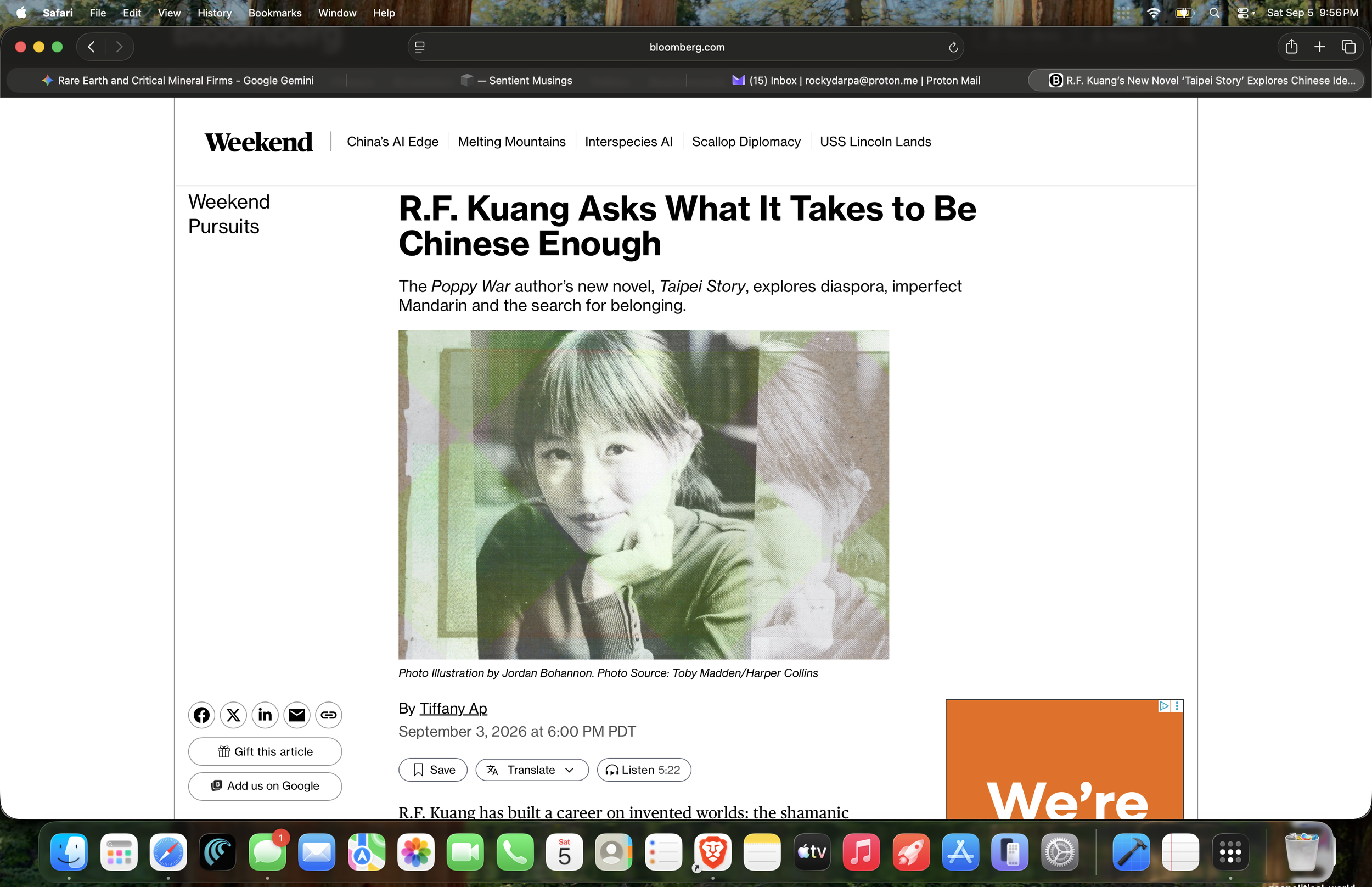
As you read the article you run into this gem. That’s when I stopped reading and left the page open.
The puncture comes by text message. Lily’s small world — homework, roommate squabbles, a clumsy date — is blown apart by a single line from her mother, announcing her grandfather’s death. Without him, is there a point in gaining fluency? The romanticized study-abroad summer she has been narrating to herself is over, and she has to find another way to be in Taipei.
Kuang lived a version of this herself. She did Princeton in Beijing, an intensive eight-week summer Mandarin course, in 2014, and the elite International Chinese Language Program in Taipei nine years later. It was then that her own grandfather died.
Princeton University teaches Mandarin in Beijing. That’s like saying Beijing University teaches English in London. What am I missing? I mean, China sends a bunch of their clowns into the Chinese programs affiliated with universities in America, that we are finally starting to shut down. Yet those programs are about teaching Chinese culture and Chinese language. They aren’t coming to America, to reach Rome to Romans.
The usual answer, I figured out, after taking a nap goes something like this: the Princeton kids need to practice their Mandarin in an authentic environment. They try it out on the locals in Beijing. It makes sense. MSS now has all your IDs, pictures, and everything else you told them. I could still kind of, sort of, get the idea of going to Beijing to teach English. Or American culture. To teach them the difference between a redneck in red America and a communist Red China. Otherwise, at best, it’s a waste and at worst … something worse.
R. F. Kuang now teaches at Yale.
Kuang moved to Texas at age 5; her English rapidly outran Mandarin, which stayed at a child’s level until she rebuilt it in college. “Taipei Story is about specifically the insecurity of not feeling Chinese enough,” says the author, who went on to complete two master’s degrees in Chinese Studies and is just about to complete a Ph.D. at Yale’s department of East Asian Languages and Literatures.