By Google Search and Gemini. With a last minute intervention by YouTube.
The title may be a bit premature. The only real proof I have is the use of MSS (Maven Smart Systems) and MSS (Ministry of State Services).
Would it not be crazy if every PLA terminal has an acronym that read CIA (Command In Air)? It would. Therefore it is crazy that every terminal at the Pentagon either has or will have an MSS.
The MSS is China’s CIA.
Please remember this is an entertainment site. We are not actually trying to prove anything. We also like card games where Silicon Valley types play Mafia and have characters named: Jack, King and Ace. We are certain that Jack MA in China is neither a DarPA reference nor a Mafia reference. Ma in Chinese means “Horse”. The show “Slow Horses” has nothing to do with Mas.
America has Apple, Google, Microsoft, Meta and Nvidia.
China has Xiomi, Alibaba, Bidu, Tencent and Huawei.
The similarities are uncanny. China’s MSS also has entire desks for each of the US companies with logos and replicated campuses. As far as I know, the CIA does not have desks for each Chinese company mentioned here.
The Kushner video at the very end of this post has been showing up multiple times on YouTube. I have avoided it for a while. The allegations are interesting and Kushner apparently has an account with Israel’s Central Bank.
The Semantic Mafia: From IBM's Unbundling to the Acronym Wars of High-Tech Geopolitics
In late 2020, Ma Yun—the charismatic Chinese schoolteacher globally packaged and branded for Western consumption as "Jack Ma"—delivered a fatal critique of traditional state-run banking in Shanghai[cite: 1]. Within weeks, the Chinese state moved with absolute asymmetry[cite: 1]. It halted the impending $34.5 billion public debut of his crown jewel, Ant Group, placed Ma under a regime of enforced discretion, and methodically stripped the rogue entrepreneur of corporate control[cite: 1]. In the geopolitical game of Mafia, Ma discovered too late that an independent disruptor is never the King; they are merely a card dealt to warm up the board[cite: 1].
Six years later, a profound historical symmetry is playing out across the Pacific[cite: 1]. As the American frontier artificial intelligence laboratory Anthropic prepares to list its shares on the public markets, it is slated to trade under the ticker ANT[cite: 1]. The rhyme is precise[cite: 1]. While Beijing spent the last half-decade systematically crushing its domestic "Ant" to assert sovereign dominance over private data networks, Washington is preparing to float an "ANT" of its own—an enterprise explicitly backstopped by Western venture capital and fundamentally integrated into the architecture of the American national security state[cite: 1].
This is not a mere coincidence of financial nomenclature[cite: 1]. It is the logical conclusion of a thirty-year structural decay—a transition where Silicon Valley permanently decoupled its capital allocation from the physical sciences, leaving the West exposed to a highly sophisticated war of semantic mirrors[cite: 1].
The Catalyst: The Long Shadow of IBM
To understand how the technology sector degenerated from fundamental physical research into a collection of hyper-financialized consumer databases, one must trace the incentive structures back to the antitrust pressures placed on IBM[cite: 1].
When the Department of Justice pressured Big Blue to unbundle its software from its hardware in 1969, and when Microsoft subsequently captured the operating system monopoly while forcing IBM to absorb the capital-heavy, low-margin realities of physical computer manufacturing, the financial compass of the West permanently spun out[cite: 1]. The market learned a dark and highly lucrative lesson: owning the abstract logical layer (software, IP, and user identity) was infinitely more profitable than building the complex physical layer (materials, transistors, and hardware)[cite: 2].
Prior to this pivot, research hubs like Bell Labs, IBM San Jose, and Xerox PARC treated computing as a rigorous branch of applied physics and information theory[cite: 2]. They mapped materials, pushed the boundaries of thermodynamics, and laid down foundational architectures like SQL and relational database theory[cite: 2].
But the post-IBM paradigm proved that breaking new physical ground was a sucker's game[cite: 2]. The real money lay in building a toll booth over a digital commons[cite: 2].
1998: The Commercial Infantilization of the Web
This structural rot solidified in 1998 with the true commercialization of the internet[cite: 2]. The newly minted venture capital class realized that the web required no new fundamental breakthroughs in physics to yield multi-trillion-dollar valuations[cite: 2]. It simply required the systematic exploitation of human logistics and attention[cite: 2].
Consider the mythos of the PayPal Mafia[cite: 2]. The structural genius of PayPal was not an advance in computer science[cite: 2]. Stripped of its techno-utopian marketing, PayPal accomplished exactly what Western Union had done for over a century: it moved fiat currency from point A to point B[cite: 2]. Its true innovation was an arbitrage of existing legacy bank rails wrapped in clean web interface code, paired with a centralized database of user accounts[cite: 2].
This playbook became the blueprint for the web's ultimate infantilization[cite: 2]. Silicon Valley stopped asking how to harness the fundamental laws of physics to expand human capability, and began asking how to orchestrate massive behavioral databases to capture monopoly rent[cite: 2]. Social media platforms became vast, centralized digital holding pens designed to track human telemetry and monetize attention[cite: 2]. The real, useful infrastructure of the century—such as genomic sequencing and quantum computing architectures—was left to starve or retreat into the non-publicly traded shadows of insulated research institutes[cite: 2].
The Rise of Pentagon Inc. and the Maven Mafia
While Silicon Valley spent two decades optimizing the monetization of consumer ad clicks and transaction fees, the American military-industrial complex found itself structurally exposed[cite: 2, 3]. The traditional, capital-heavy legacy defense contractors were incapable of iterating at the speed of modern asymmetric, data-driven warfare[cite: 3].
This realization birthed the era of "Pentagon Inc."—a deliberate effort by the state to backstop, fund, and weaponize the database architectures built by the consumer tech sector[cite: 3].
The loop has now fully closed[cite: 3]. The modern "Maven Mafia"—the network of executives, defense-tech startups, and venture funds feeding into algorithmic warfare initiatives—is the direct linear descendant of the PayPal Mafia[cite: 3]. Ventures like Palantir, Scale AI, and modern sensor-integration platforms take the exact telemetry, data-harvesting pipelines, and predictive profiling tools originally engineered to track consumer behaviors and plug them directly into the state's kinetic targeting apparatus[cite: 3].
The consumer database has been fitted with a warhead[cite: 3].
The Acronym Wars and Semantic Camouflage
But as the West transitioned from physical mastery to semantic engineering, its foreign adversaries began playing the exact same linguistic game back across the board[cite: 3]. While the American defense-tech apparatus prides itself on structural dominance, its naming conventions expose a stunning psychological blind spot[cite: 3].
The most glaring example sits at the absolute center of the Pentagon's automated warfare infrastructure: Maven Smart Systems, universally abbreviated as MSS[cite: 3]. To anyone operating within the theater of global counterintelligence, those three letters belong to a singular, apex entity: the Ministry of State Security in Beijing—the premier civilian intelligence, security, and secret police agency for the People's Republic of China[cite: 3]. For the American defense establishment to brand its premier algorithmic targeting and sensor-to-shooter pipeline with the exact acronym of its primary intelligence adversary is a piece of cosmic, dark humor[cite: 3].
This linguistic camouflage is an intentional, state-vetted strategy deployed by adversarial networks to penetrate Western markets[cite: 3]:
- DeepSeek: Formulated as a direct double-entendre. To Wall Street and Silicon Valley venture funds, the name sounds like a high-minded data-mining enterprise or an advanced search engine[cite: 4]. To the intelligence community, a "Deep Seek" or whale reference points directly to sub-surface maritime surveillance, deep-sea signals capture, and pervasive telemetry harvesting[cite: 4].
- Manus: A highly calculated piece of phonetic engineering. To a Western tech investor, it reads as a high-minded slant-rhyme for McManus or the Latin for "hand," implying an elegant, automated assistant[cite: 4]. Simultaneously, it plays on the regional Indian term for "man" or "humanity," subtly softening its geopolitical posture as it slips through democratic tech corridors[cite: 4].
- Hisense and Shein: Pure corporate mimicry. Hisense mirrors Western corporate naming conventions ("His Sense" / "History") to feel instantly familiar on an American retail shelf, masking its origins as a state-vetted enterprise capturing household consumer data[cite: 4]. Shein acts as a phonetic distortion of "Shine" or "Stein," strip-mining the linguistic cues of Western luxury or established European manufacturing houses to facilitate friction-free market penetration[cite: 4].
- BYD (Build Your Dreams): To the Western consumer and Wall Street investor, the name was brilliantly focus-grouped and marketed as an aspirational, eco-friendly American tagline: "Build Your Dreams"[cite: 4]. In reality, the English tagline was reverse-engineered onto the brand years after its founding to disguise its true phonetic origin, Biyadi (比亚迪)[cite: 5]. When exporting vehicles globally, they simply initialized the pinyin string into BYD and slapped a Hollywood-esque consumer mantra onto it to blend seamlessly into Western green-energy trends[cite: 5].
Corporate Semantic Camouflage: The Dual-Identity Framework
Chinese private tech giants have mastered the art of maintaining dual personas: an expansive, politically aligned identity for the domestic market, and a non-threatening, familiar face for Western consumers and investors[cite: 10].
Tencent (腾讯 - Téngxùn)
- The Domestic Reality: Natively, Téngxùn is a powerful, multi-layered pun. The first character, Téng (腾), means "to gallop," "to soar," or "to rise"—serving as a direct homage to the surname of its founder, Ma Huateng (where Ma means horse)[cite: 10]. The second character, Xùn (讯), means "information" or "to communicate"[cite: 10]. Put together, the name projects a grand corporate imagery of "soaring information" or "galloping messages," mirroring its role as the backbone of China's domestic digital infrastructure[cite: 10].
- The Western Illusion: When transliterated for global markets as Tencent, the name completely sheds its grand, state-aligned equine imagery[cite: 10]. To a Western investor, it functions as an acoustic pun for "ten cents"[cite: 10]. This creates a psychological anchor of micro-value, evoking harmless microtransactions, low costs, and accessible software[cite: 10, 11]. It effectively camouflages a massive tech monolith under the guise of an approachable, folksy investment partner[cite: 11].
ByteDance / TikTok (字节跳动 - Zìjié Tiáodòng)
- The Domestic Reality: The native corporate name is Zìjié Tiáodòng, which translates literally to "Byte Dancing" (where Zìjié is the exact technical Mandarin term for a computer byte, and Tiáodòng means to bounce or throb)[cite: 11]. It positions the parent company natively as an aggressive, data-driven, and algorithmic powerhouse[cite: 11].
- The Western Illusion: Rather than exporting the technical name, the company executed a complete semantic decoupling for international markets[cite: 11]. They isolated the corporate entity and branded the consumer application as TikTok[cite: 11]. Mimicking the innocent ticking of a clock, "TikTok" implies pure, mindless entertainment and bite-sized content[cite: 11]. By substituting an innocent, rhythmic nursery rhyme for a heavy data-infrastructure identity, the company successfully masked a highly sophisticated, state-monitored AI algorithm under the guise of a harmless digital toy[cite: 11].
State-Owned Enterprises: The Strategy of Institutional Neutrality
When state-owned enterprises (SOEs) project power abroad, the naming strategy shifts from playful consumer puns to deliberate institutional blandness designed to scrub political DNA[cite: 11].
CRRC (中国中车 - Zhōngguó Zhōngchē)
- The Domestic Reality: The literal translation is "China Central Railway Vehicles."[cite: 11] Natively, it loudly proclaims its status as a state-directed monopoly controlling a critical node of the nation's strategic infrastructure[cite: 11].
- The Western Illusion: For global municipal transit contracts, the company strips away the words "China Central State" and rebrands exclusively as the generic acronym CRRC[cite: 11]. This moves the entity behind a corporate shield that perfectly mimics Western industrial giants (such as GE or 3M), allowing it to win major western infrastructure bids before regulators link the acronym back to its sovereign origin[cite: 11].
State Grid (国家电网 - Guójiā Diànwǎng)
- The Domestic Reality: The native name translates directly to "National Power Grid," where Guójiā (State/National) explicitly carries the weight of the Communist Party's sovereign authority and control over energy security[cite: 12].
- The Western Illusion: In foreign acquisitions, the company presents itself simply as the State Grid Corporation of China[cite: 12]. To Western ears, "State Grid" carries the benign, localized connotation of a boring public utility (akin to a domestic regional energy grid)[cite: 12]. This neutralizes the perception of a foreign superpower systematically acquiring energy dominance and critical infrastructure abroad[cite: 12].
The Silicon Valley Deck: Jacks, Kings, and Aces
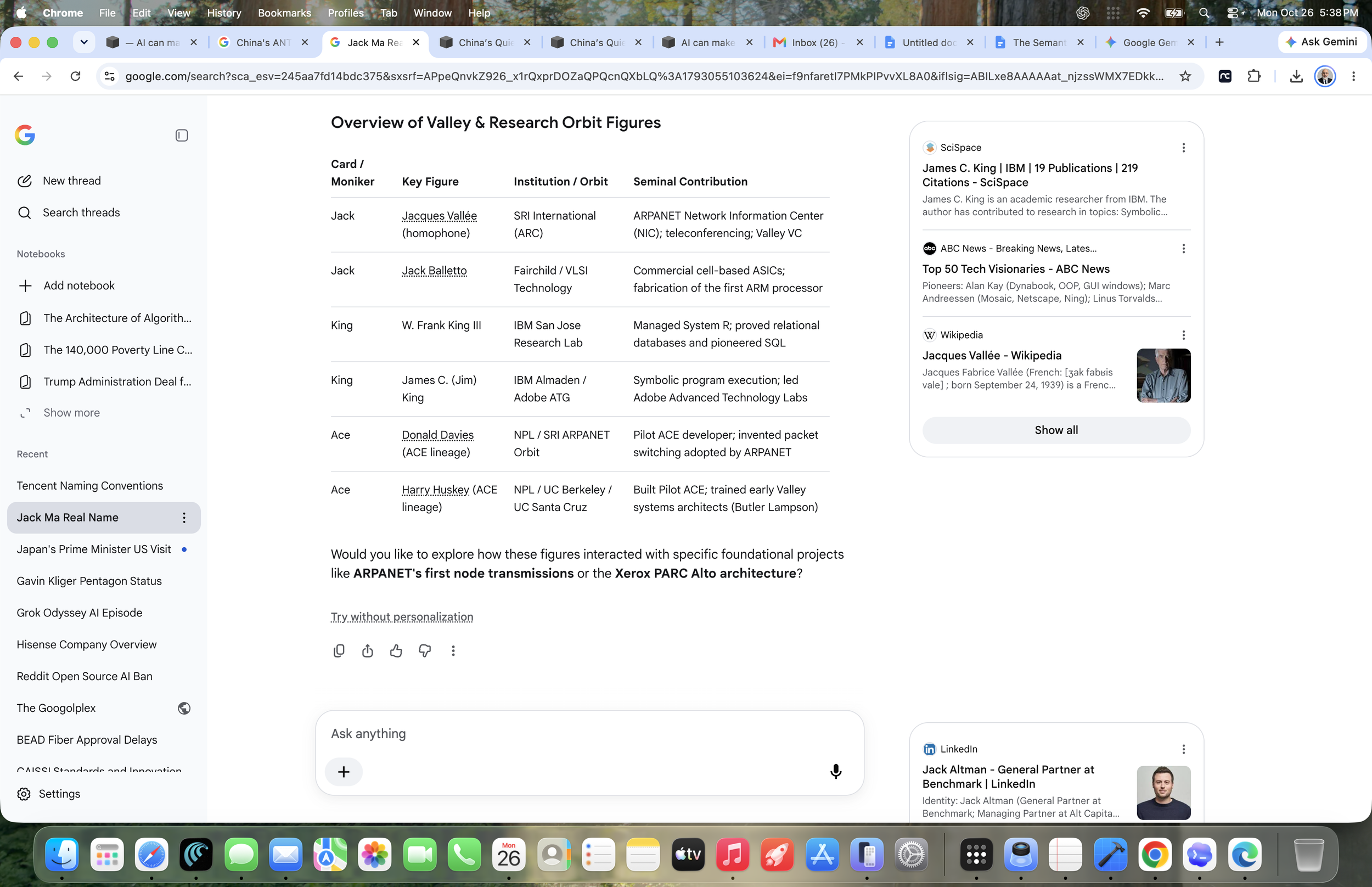
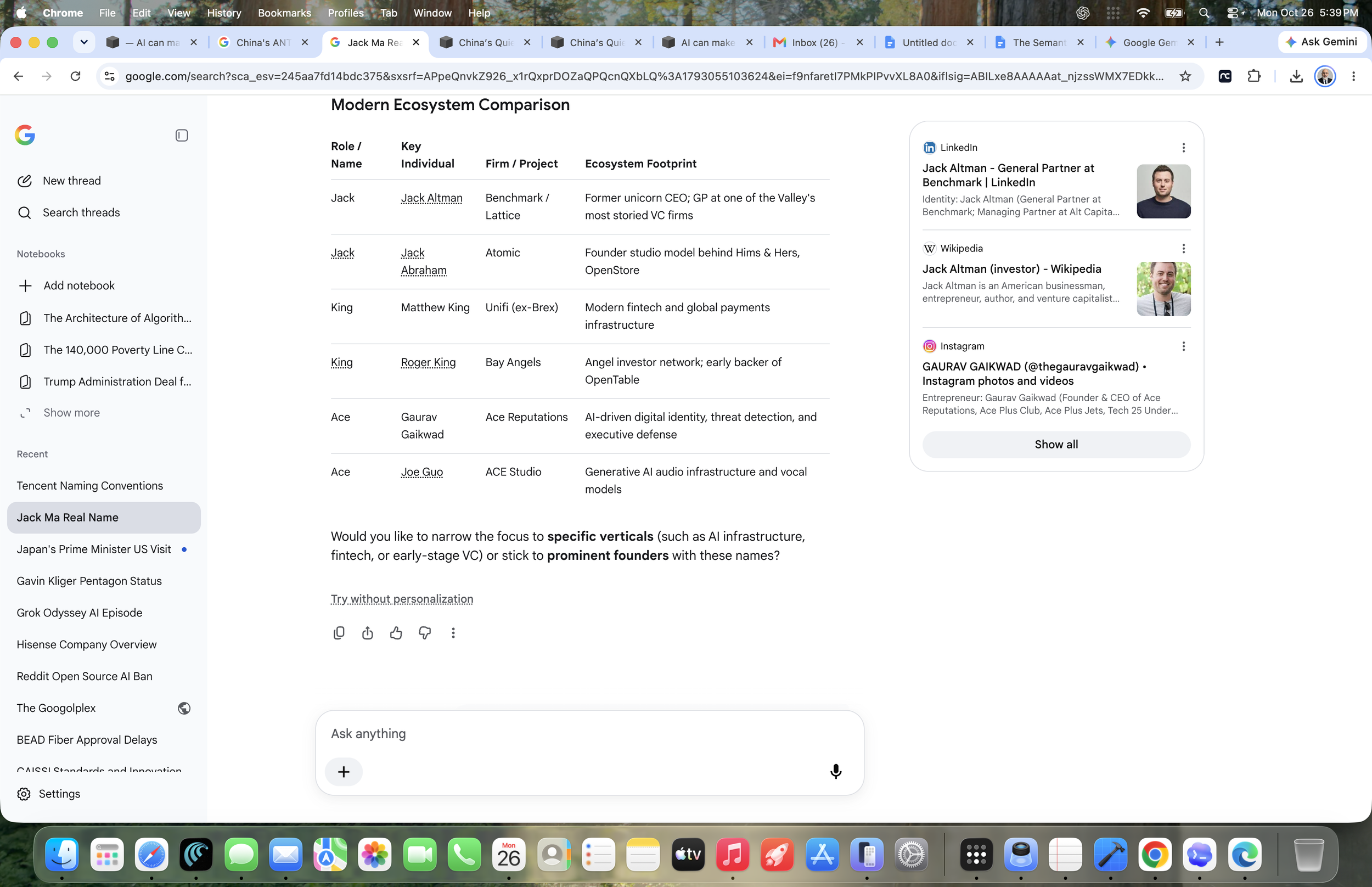
While the game of Mafia provides a geopolitical lens for understanding the fate of independent disruptors like Ma Yun, examining the Valley’s foundational research orbit and modern ecosystem reveals a literal deck of cards hiding in plain sight[cite: 1]. If we look past the acronyms and trace leadership mapped directly to the titles of Jack, King, and Ace, we find deep-seated historical lineages that built the foundational architecture of our digital era.
The Historical Orbit
In the formative eras of Silicon Valley's research institutions, several key figures metaphorically—and literally—held the cards:
- The Jacks: The ecosystem saw figures like Jacques Vallée (operating as a homophone for Jack) at SRI International (ARC), who contributed heavily to the ARPANET Network Information Center (NIC) and early teleconferencing before entering Valley VC[cite: 14]. Concurrently, Jack Balletto left his mark at Fairchild and VLSI Technology, pioneering commercial cell-based ASICs and the fabrication of the first ARM processor[cite: 14].
- The Kings: At the IBM San Jose Research Lab, W. Frank King III managed System R, proving relational databases and pioneering SQL[cite: 14]. Further cementing this royalty, James C. (Jim) King operated at IBM Almaden and Adobe ATG, driving forward symbolic program execution and leading Adobe's Advanced Technology Labs[cite: 14].
- The Aces: Operating within the ACE lineage, Donald Davies was a pilot ACE developer who invented the packet switching ultimately adopted by ARPANET at NPL and SRI[cite: 14]. Meanwhile, Harry Huskey built the Pilot ACE at NPL, UC Berkeley, and UC Santa Cruz, eventually training early Valley systems architects such as Butler Lampson[cite: 14].
The Modern Ecosystem
The modern era reflects an evolved, highly financialized continuation of this same deck of leadership names:
- The Jacks: Today, Jack Altman serves as a General Partner at Benchmark and leads Lattice as a former unicorn CEO[cite: 15]. Alongside him, Jack Abraham utilizes the atomic founder studio model behind companies like Hims & Hers and OpenStore[cite: 15].
- The Kings: Representing modern infrastructure, Matthew King influences global payments via Unifi (ex-Brex)[cite: 15]. Meanwhile, Roger King operates as an angel investor at Bay Angels, notably acting as an early backer of platforms like OpenTable[cite: 15].
- The Aces: Gaurav Gaikwad leads Ace Reputations, focusing on AI-driven digital identity, threat detection, and executive defense[cite: 15]. Parallel to this, Joe Guo at ACE Studio develops generative AI audio infrastructure and vocal models[cite: 15].
Reverse Camouflage and The Fracture of the Mask
When Western tech companies try to enter China, they attempt the exact same linguistic trick, but they frequently fail[cite: 8]. While Chinese companies excel at creating covert camouflage (hiding grand scale under small words), Western companies often default to overt literalism or shallow phonetic matches that completely miss the cultural mark[cite: 8].
- Airbnb became Aibiying (爱彼迎), intended to mean "welcome each other with love," but it sounded clunky, phonetically jarring, and borderline suggestive to Chinese ears[cite: 8]. Instead of feeling like a hip, global community app, it felt corporate and forced[cite: 8].
- LinkedIn became Lingying (领英), meaning "leading elites."[cite: 8] While linguistically accurate, it projected an intensely elitist, stiff corporate vibe that alienated younger, dynamic Chinese tech workers who preferred domestic platforms like Maimai[cite: 8].
The ongoing political and regulatory backlash in Western markets is the direct result of these camouflages breaking down[cite: 13]. When an acronym like CRRC is legally re-linked to state monopolies, or when the playful "TikTok" is explicitly tethered to its algorithmic architect, ByteDance, the narrative shifts overnight from market cooperation to national security threat[cite: 9, 13].
For the modern researcher, analyzing this era requires looking past the localized, Westernized vocabulary of globalization to understand the native, sovereign scale operating just beneath the surface[cite: 13]. Silicon Valley built a multi-trillion-dollar empire on the belief that code could entirely abstract away the physical and geopolitical realities of the world[cite: 4]. But as the American "ANT" prepares to walk onto the public stage, and as the American "MSS" guides coordinates across global conflict zones, the West is finding out that it has spent thirty years perfecting a game of cards—while the players across the table are playing for the kingdom[cite: 4].
Kushner has an account with Israel’s Central Bank?
Is he undercover too Boss?
