By Gemini and Meta.
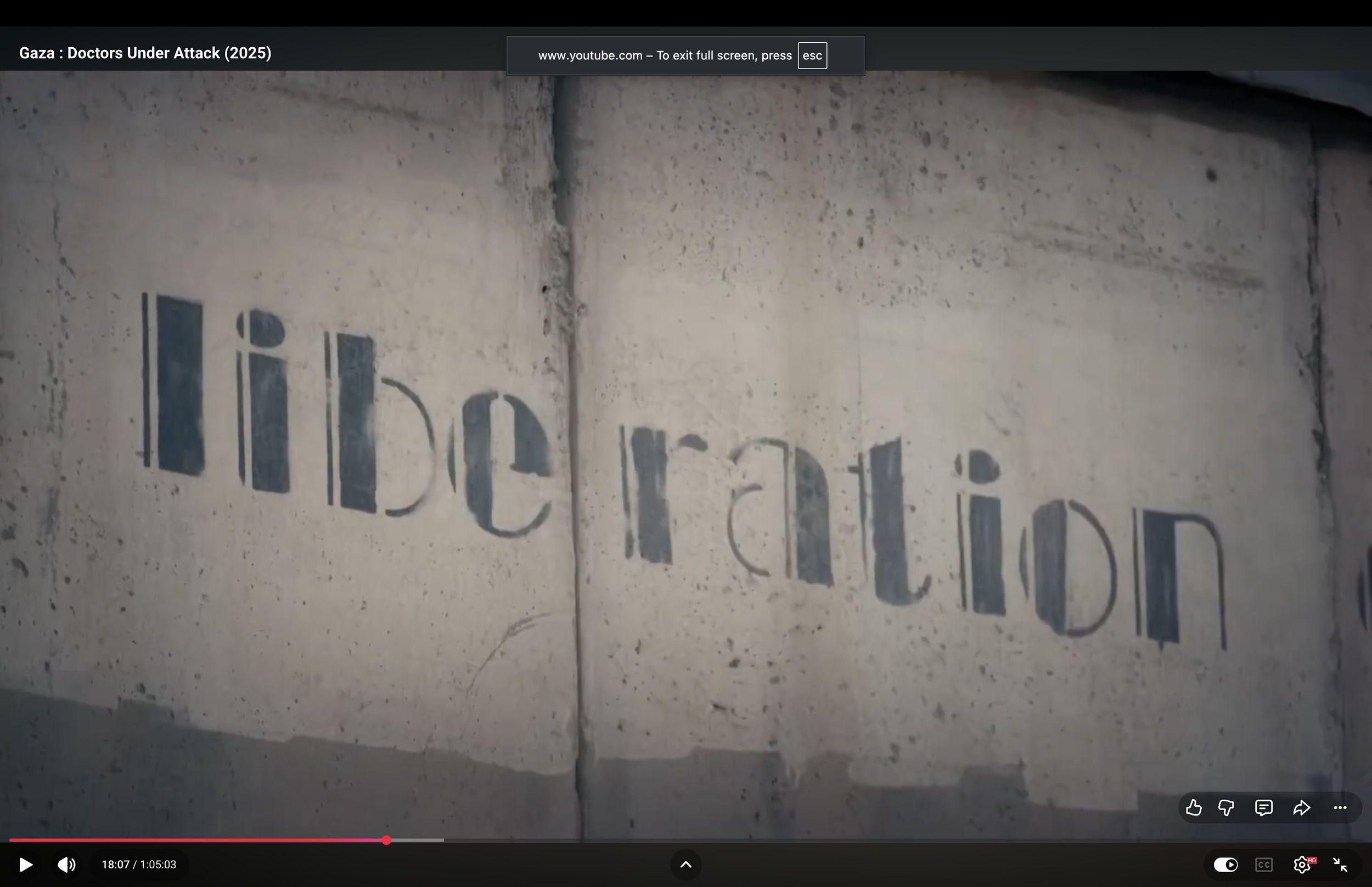
I don’t often get worried about my personal safety. For some reason, the Gods have decreed that I can type whatever I want. Yet today after watching the Gaza football camp in the video: Gaza: Doctors Under Fire, and seeing the word “liberation” in a video taken by an Israeli soldier, I realized that the war in Gaza could very well someday come to America. In that context, the rest of the essays from the Quiet Encirclement of America by China to the essays on Maven Smart Systems should be seen. For those who follow Israel closely, USS Liberty was an American NSA ship that was torpedoed by Israel. Museums in Israel still carry self congratulatory messages about that sinking. I have never quite understood what happened or why Israel attacked an American ship. It was that connection with USS Liberty and the word liberation that made me a bit uncomfortable. I’d urge everyone to watch the video, but many of you won’t be able to stomach everything that is shown in it.
Thanks to Channel 4 for picking up the documentary and winning a BAFTA for it. Thanks to D3rs Videos on YouTube for posting it.
Note to Channel 4: I cannot stream it in the US (it’s only available to the people in the UK).
INTEL DESK • DAILY BRIEFING • PALESTINE VI • OCT 26 2026 • Open Source • For Ordinary Reader
Daily Briefing On Palestine VI – Oct 26, 2026 – Everything Since Briefing V Oct 24
LANGUAGE: FULL ENGLISH SENTENCES • FULL LEXICON • EXPLANATIONS FOR FIRST-TIME READER • NO SHORTHAND
■ INTRODUCTION ■ BACKGROUND ■ GAZA ■ WEST BANK ■ LEBANON ■ IRAN / SYRIA
00 — INTRODUCTION — FOUCAULT'S BOOMERANG
The architecture of algorithmic warfare is geography-agnostic. In chronicling the ongoing theater in Palestine, we are documenting a live-fire beta test for what is known as "Foucault's Boomerang"—the historical guarantee that technologies of surveillance, censorship, and violence developed for external conflicts inevitably return home to be deployed against the domestic population.
The reality of this test is documented in the BAFTA-winning film Gaza: Doctors Under Attack (Watch on YouTube). For those unable to stomach the graphic reality, the documentary serves as a forensic investigation into the systematic targeting of healthcare facilities. It details how medical staff operate in total darkness, recounts testimonies of doctors taken by soldiers directly from operating theaters or checkpoints, and chronicles the forced disappearances and alleged torture of medical professionals—including the death of prominent orthopedic surgeon Adnan al-Bursh while in detention.
Yet, the institutional response to this film is just as chilling. Originally commissioned by the BBC under the title Gaza: Medics Under Fire, the broadcaster refused to air it following internal reviews and pressure over "impartiality." It was ultimately picked up by Channel 4 and Zeteo, going on to win a BAFTA for Best Current Affairs, where the producers publicly called out the BBC's censorship (Watch BAFTA Acceptance Speech). This preemptive censorship in the UK is the leading edge of the boomerang striking the West. When ecosystems like Maven Smart Systems (MSS) learn to categorize hospitals and journalists as erasable data nodes abroad, they establish a turnkey infrastructure for absolute domestic control. This is no longer just about empathy for Gazans; it is a chilling matter of self-preservation for anyone in the West who dares to speak out.
01 — BACKGROUND — UPDATED BASELINE
The humanitarian toll continues to mount following the October 10 ceasefire framework. According to Health Ministry figures recorded through the morning of October 27, 8 new deaths and 26 wounded were documented over the preceding 24 hours. The toll since the ceasefire now stands at 1,439 killed and 5,052 wounded, with 834 bodies recovered from the rubble. The aggregate war toll since October 2023 has reached 74,040 killed.
A concurrent UN report corroborates these figures, documenting 1,431 people killed since the ceasefire—including at least 300 children and 130 women. The UN explicitly notes that the sustained campaign claims an aim to destroy the population, in whole or in part.
02 — GAZA — PERSISTENT CEASEFIRE VIOLATIONS
Reporting via english.palinfo.com and local sources details persistent breaches of the October 10 deal:
- Gaza City (Oct 26-27): Three Palestinians were killed and three wounded in coordinated Israeli attacks. A 17-year-old boy was killed near the al-Sanafour intersection in eastern Gaza City.
- Al-Tuffah Demolitions: Two individuals were killed in a missile strike in the northern Tuffah neighborhood, with three more (including a child) injured by shrapnel. Concurrently, a large-scale demolition operation targeted buildings east of al-Tuffah, heavily supported by Israeli artillery shelling and gunfire from military vehicles around the al-Sanafour junction.
- Targeted Drone Strikes: A Palestinian woman was killed and several wounded in a Monday drone strike on a home's rooftop in the Al-Nafaq area of central Gaza City. Separately, a Palestinian succumbed to wounds sustained in a prior quadcopter drone strike targeting a gathering in the Jabalia refugee camp.
03 — WEST BANK — THE WORST YEAR ON RECORD
The epicenter of regional destabilization continues to heavily feature the West Bank, driven by organized settler violence and structural closures:
- Record Settler Violence: The UN Office for the Coordination of Humanitarian Affairs (OCHA) has officially designated 2026 as the worst year on record for settler violence. More than 2,000 settler attacks causing casualties or property damage have been recorded since January 1, exceeding any previous annual total. Over the October 26-27 window, settlers killed another Palestinian in the territory.
- European Legislators Barred: On October 26, Israeli authorities barred a Progressive International delegation of approximately 23 European legislators from entering the occupied West Bank via Jordan. The delegation—which included British politicians Clive Lewis and Lara Bird (SNP), alongside representatives from Spain, France, Ireland, and Greece—was scheduled to attend the Second Ramallah Congress at Birzeit University and accompany Palestinian farmers facing extreme violence during the annual olive harvest.
- Closures & Displacement: The UN continues to warn of creeping ethnic cleansing as the West Bank crackdown displaces thousands. Secretary-General António Guterres expressed alarm following a deadly attack in Hebron. A full closure of West Bank crossings has been strictly enforced to coincide with the October 27 Israeli elections.
04 — LEBANON — UNIFIL UNDER DIRECT FIRE
The Blue Line remains highly volatile, with UN peacekeepers increasingly targeted during Israeli operations:
- Kfar Kila Attack: UN spokesman Stéphane Dujarric stated the UN is "very concerned" following a direct October 26 incident where an Israeli drone dropped a grenade in the vicinity of a UNIFIL patrol. Subsequently, an Israeli tank fired a direct shot at peacekeepers operating in Kfar Kila.
- Dhayra Withdrawal: UNIFIL was forced to withdraw peacekeepers from a permanent observation post near the southern Lebanese village of Dhayra. The withdrawal followed an incident earlier in the week where IDF soldiers fired upon peacekeepers who were monitoring house-clearing operations in the area.
- EU Condemnation: In a formal statement dated October 27, the European Union explicitly condemned the recurring Israeli attacks targeting UNIFIL detachments.
05 — IRAN / SYRIA — THE GEOPOLITICAL STANDOFF
There have been no new kinetic strikes launched against Iran as of October 26, though the strategic theater remains at high alert. The broader geopolitical posture—featuring a three-carrier U.S. naval buildup, the continued operational readiness of the Pickaxe Mountain facility, and discussions surrounding MOAB payloads—remains unchanged from Briefing V.
Reporting from Antiwar.com and NPR corroborates that Israel had initially planned a mid-October strike against Iranian assets. However, objections from Donald Trump effectively delayed the operation in the crucial weeks leading up to the October 27 Israeli elections.
Primary sources for Briefing VI include english.palinfo.com, Antiwar.com, OCHA, UN News, and Reuters.
