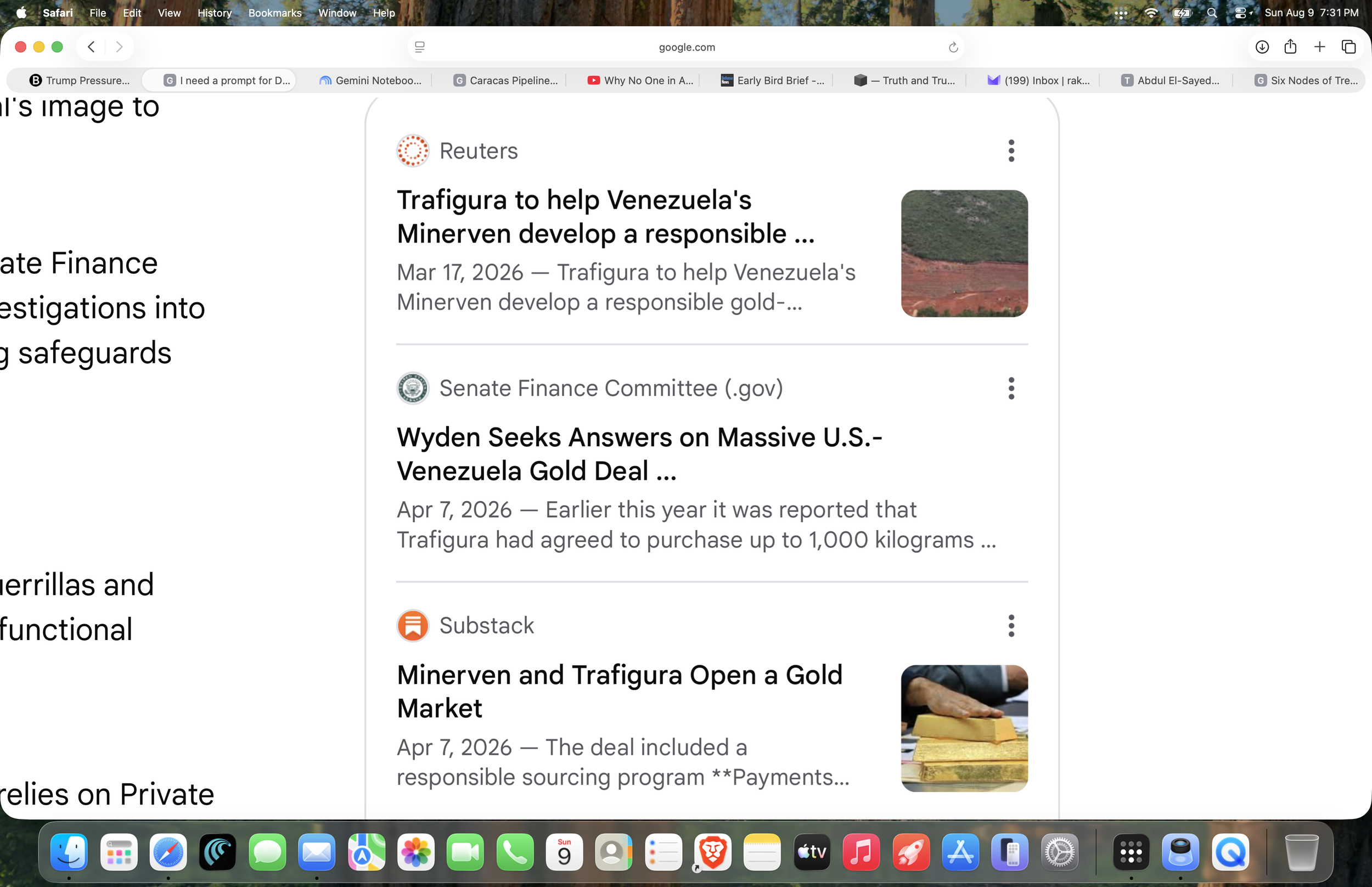
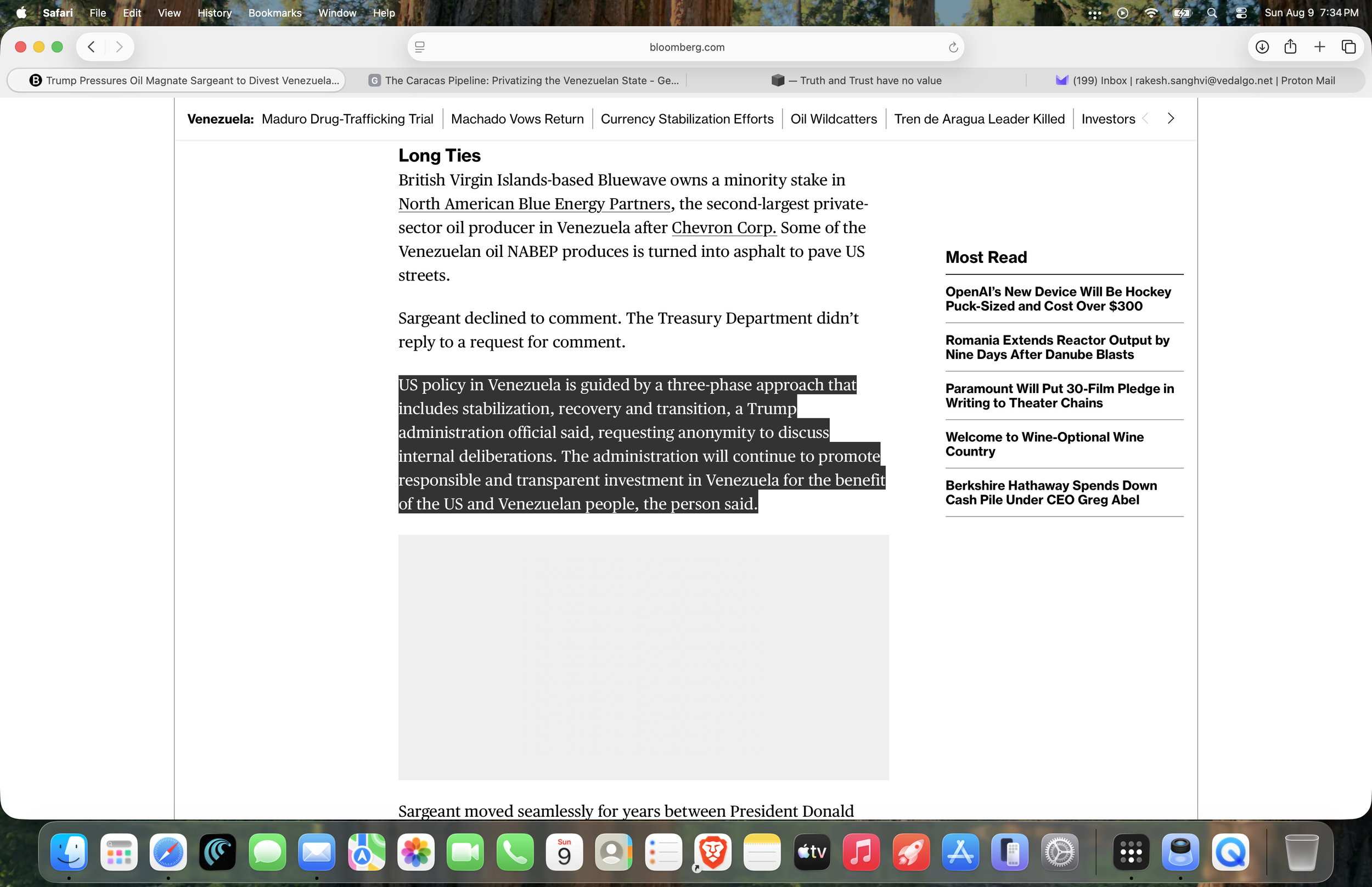
PODCAST: The Corporate Receivership of Venezuela.
There are strategic goals, and then there are strategic goals carried out clumsily and corruptly by those in power. Every nation should have—indeed, usually does have—clear strategic objectives across short-, medium- and long-term horizons; that is hardly debatable. For example, given America’s current defense technologies, a sensible short-term strategic aim would be to break free from China’s chokehold on the rare earths essential for producing advanced weaponry. If we cannot at least agree on that basic point, there is little common ground left to find. What matters, however, is not merely the goal but how one chooses to achieve it, and how it is being pursued today is precisely the subject of this podcast. Listen, then come back and reconsider this comment.
Credits: Research for this podcast began with Cappy Army’s video “It’s Not Drugs.” Before that, I had no idea the C.I.A. maintains a covert special-ops unit called Ground Branch. Then again, I regularly photograph literal broken tree branches that lead nowhere, so my talent for finding hidden things is embarrassingly consistent.
This is not an exposé. It almost wasn’t a podcast at all. I hesitated—for reasons you’d expect: national security, clandestine operations, don’t-tickle-America’s-supply-chain. What pushed me over the edge was less patriotism and more arithmetic: Venezuela’s oil proceeds have been evaporating into U.S. coffers. After an initial diversion of $500 million to Qatar, of roughly $19 billion in oil revenue, Venezuela has reportedly seen only about $400 million returned. That’s not incompetence. That smells like deliberate appropriation.
When your federal treasury appears on the receiving end of that sort of financial jujitsu, it stops being an abstract geopolitical story and becomes a direct line to motive. Follow the money and you start to see patterns: clandestine forces clearing zones, then commerce moving in, then mineral deals closing. If Ground Branch operations are functioning as the tactical broom—sweep out the “bad actors”—what fills the sweeped space? Corporations. Contracts. Extraction.
Call it pragmatic imperialism, call it strategic resource acquisition, call it business-as-usual with a black-ops preface. The mechanism is tidy: use covert operations to stabilize—or destabilize—a region, and then secure access to valuable minerals and contracts for private interests. It’s an efficient sequence if your priority is resource control over transparent sovereignty.
So this podcast isn’t a conspiracy theory dressed up in tinfoil. It’s a string of documents, transactions, and tactical patterns that, when linked, sketch a plausible template: clandestine force creates conditions; commerce flows in; billions in mineral wealth follow. That template is why I bothered to investigate—and why you should listen.
Is pragmatic imperialism wrong when it is to achieve a strategic objective? That’s a decision for Congress and the Senate. Is theft wrong? I mean ultimately that’s what imperialism always was. Those are the weighty questions, America should ask itself, in 2026. Perhaps we are in the wrong class, perhaps in the wrong theatre. Perhaps this move towards commercializing the military was displayed when a billionaire offered to pay military salaries during Covid. And the US Military gratefully accepted it. If military traditions have no meaning, then all is well, I suppose.
PODCAST: The Corporate Raid on Post-Maduro Venezuela (1 of 2). The second podcast will be posted here later. It is still being constructed per Gemini’s NotebookLM.
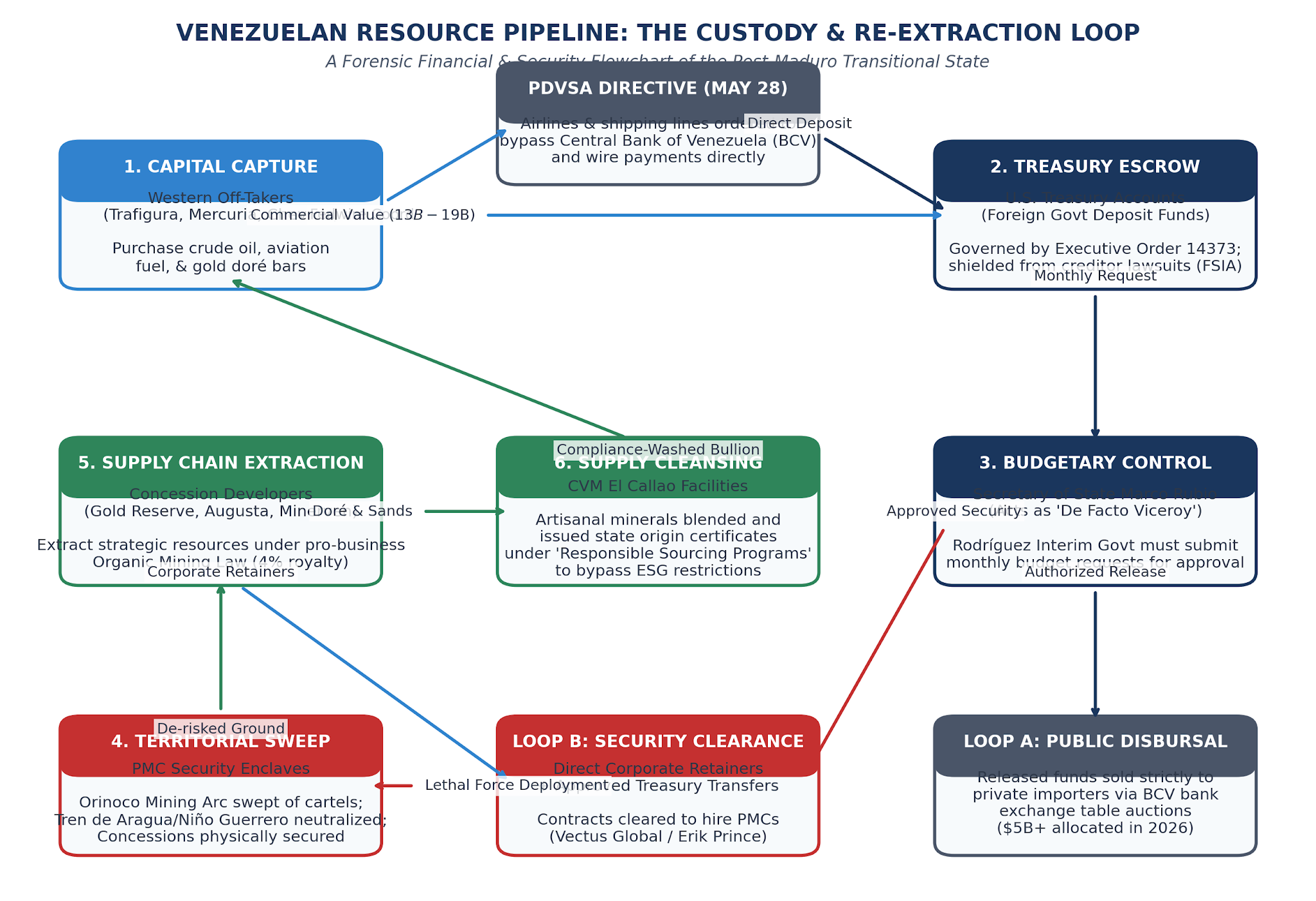
The Six Interconnected Nodes of Treasury Money Flow.
https://docs.google.com/document/d/1WN-MY6vYhvOODbslUKzDsfc_UWkXTLymR3cXoOJOZOI/edit?usp=sharing
Executive Brief on Venezuela
https://docs.google.com/document/d/1XPZOcX4ujacPddyDbCcvMRTjOFqEDvYJStaVgZvx2v0/edit?usp=sharing