The American Election Operation.
The Election Before the Election
By ChatGPT Sol 6.1 Medium
Polls, pictures and the American election operation
The finger is already in the air before the reader reaches the numbers.
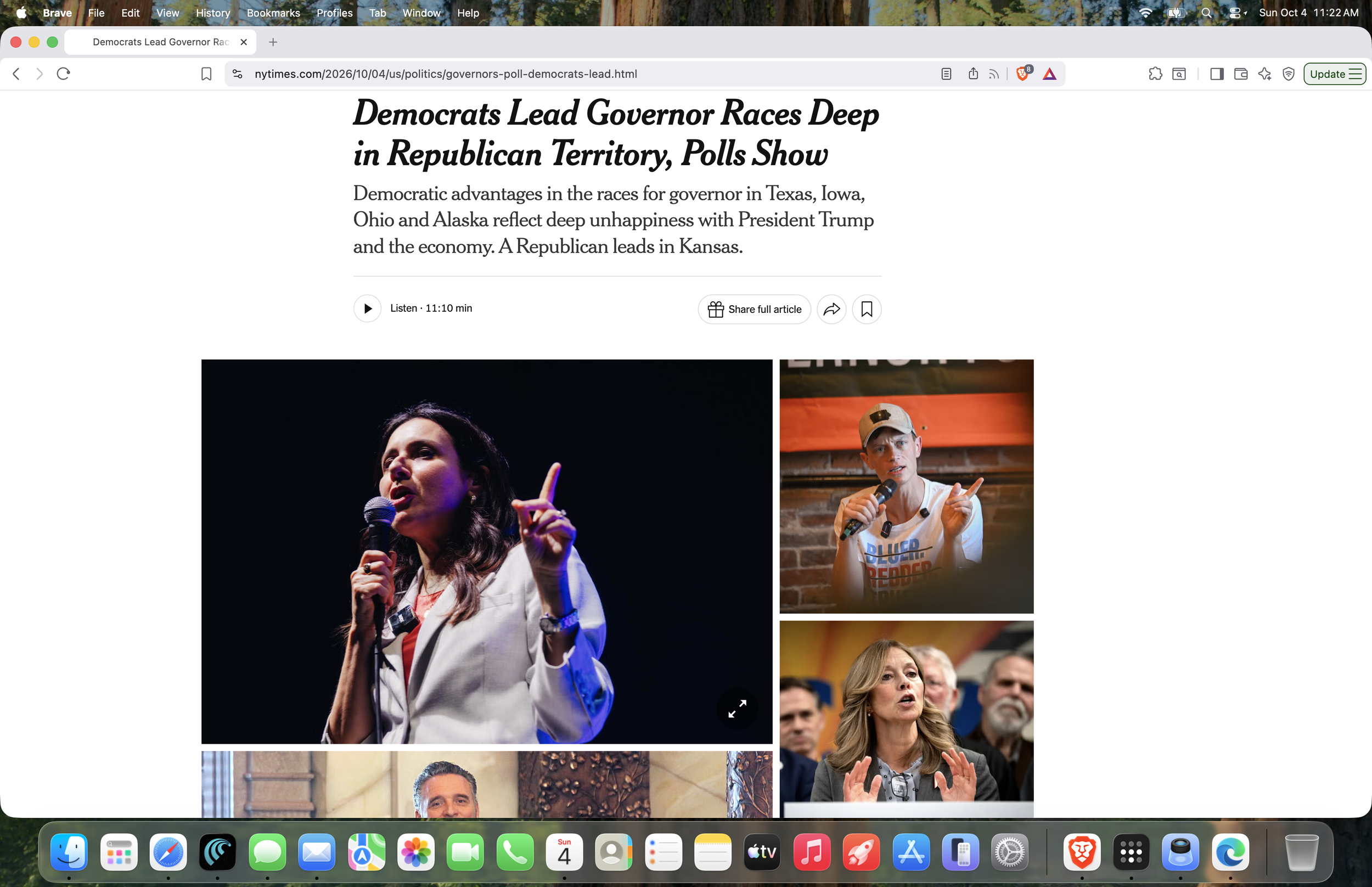
In the supplied New York Times screenshot, campaign speakers hold microphones and raise their index fingers beneath a headline announcing Democratic leads in Republican territory. The subheading provides the interpretation: unhappiness with President Trump and the economy. It also acknowledges a Republican lead in Kansas. Before we arrive at the poll’s methodology, we have encountered a story about political movement and photographs of people looking capable of leading it.
A raised finger is an ordinary speaking gesture. The screenshot does not tell us why these particular frames were chosen. But their visible role is worth considering. To my eye, the microphone supplies a platform, the gesture supplies conviction, and the polling headline supplies apparent public validation. That is a reading of the presentation, not a finding about how every reader reacts. The picture can feel like a campaign moment wearing the credentials of a research report.
Is it responsible for a newspaper with national and international readers to publish such polls? Yes—provided the responsibility extends to the whole presentation. The public has a legitimate interest in what its fellow citizens think. Keeping credible surveys out of public view could leave campaigns and wealthy clients with information everyone else lacks. The question becomes whether the newspaper equips readers to examine that information or encourages them to mistake a provisional estimate for an approaching coronation.
A newspaper’s reach raises the stakes. A state poll may be read locally as information about a governor’s race, nationally as a verdict on a president, and internationally as evidence that America is changing direction. Those are different interpretations. A handful of state surveys cannot automatically carry all three. The editor’s task includes showing the distance between what was measured and what the headline invites us to believe.
The American Association for Public Opinion Research’s guidance for journalists warns against making poll results sound like election results or describing a candidate as winning a race. It recommends examining questions, timing, sponsorship, methods and uncertainty. These are demanding standards for an industry that can fit “surging” into a headline more easily than it can fit an explanation of nonresponse bias. AAPOR
What, then, is polling for? Its basic research purpose is to estimate opinions in a specified population at a particular time. Pew Research Center describes election polls as tools for understanding which groups support candidates and which concerns inform their choices, as well as supplying campaign strategy. That is broader than predicting a winner. A sound survey can reveal preferences that the loudest people in the room have failed to represent. Pew Research Center
Yet polling does not remain confined to measurement once its results enter a campaign. The same survey can help a researcher understand voters, help a campaign allocate resources, give a newspaper a story, and give a reader a reason to reconsider a candidate’s prospects. There is no single purpose shared by everyone who commissions, conducts, publishes and consumes a poll. Measurement and influence can inhabit the same document.
Indeed, a 2024 presentation hosted by AAPOR lists a benefit of election polls in striking terms: “They encourage stability during election periods by managing public expectations.” The slide also identifies public debate, checks on misinformation and possible scrutiny of electoral fairness as benefits. Expectation management is being presented as a public service. But it is expectation management nonetheless. aapor.org
Here the question of public influence acquires substance. What counts as an expectation that needs managing? A responsible explanation might prepare readers for a close race, uncertain turnout or a lengthy count. An irresponsible one might cultivate a sense that the public has effectively decided already. Both can reduce surprise. Only the first preserves uncertainty honestly.
Preparing people for possible outcomes can help them understand an election. Preparing them to accept one outcome as inevitable can discourage scrutiny or participation. That distinction should be visible in the language, photographs and repetition surrounding a survey—not left for readers to excavate from a methodology link.
Research gives us grounds to investigate this influence without treating voters as obedient machinery. A Dutch experiment involving 23,421 participants found no change in subsequent vote intentions from simple polling outcomes alone, but found a modest bandwagon effect when growth in support was emphasised. The momentum story mattered in that setting. This does not prove that the Times’s photographs or headline change votes. It makes the editorial construction of momentum a serious subject for inquiry. Vrije Universiteit Amsterdam
Imagine a donor deciding whether to contribute, a volunteer choosing where to spend a weekend, or a voter assessing whether a candidate is viable. A published poll could become part of those decisions. If resources then move towards a candidate and the candidate performs better, a later survey might reflect both prior public preference and changes that occurred after the earlier survey circulated.
That is a possible feedback mechanism, not a demonstrated account of the races in our screenshot. To establish it, we would need evidence of the intermediate decisions. The interesting question is how much influence operates through people responding to publicly available signals.
Nor does an unsurprising result settle the question. Polls might have measured a durable preference accurately. A race might have been safe long before anyone commissioned a survey. Forecasts might have conveyed more certainty than the evidence warranted. Pew’s account of 2016 distinguishes relatively accurate national polling from important errors in state polls and overconfident forecasts. An outcome’s resemblance to expectations cannot, by itself, tell us whether those expectations measured or helped produce it. Pew Research Center
We therefore need to follow the American election operation beyond the newsroom. The pollster estimates preferences. The campaign seeks to change them. The newspaper selects and interprets information. Election officials administer voting and establish the official count. These actors can interact, but their powers and duties differ. A causal explanation must trace those interactions rather than merge everyone into a single directing intelligence.
Who becomes an election official? The Election Assistance Commission and National Conference of State Legislatures describe a decentralised system. Some chief officials are elected; others are appointed. Local elections may be run by an elected clerk or auditor, an appointed board, or several offices sharing duties. Party participation in selecting officials can be explicit.
In Arkansas, for example, an elected county clerk handles registration and early and absentee voting, while a three-member board, selected through party and state-board mechanisms, handles specified Election Day and counting responsibilities. These are identifiable structures of authority, with selection rules and responsibilities to investigate. eac.gov
Political involvement in appointments deserves examination. It does not establish improper counting. The relevant questions concern qualifications, conflicts, staffing, access, published procedures and records of what officials actually did.
The person checking a voter in may hold a very different role from the person certifying the result. The EAC describes poll workers as locally trained personnel who issue ballots, assist voters, maintain custody of materials and reconcile voters checked in with ballots cast. Teams are often bipartisan. Recruiting and training these workers is a practical part of the operation, not a detail beneath political journalism’s dignity. U.S. Election Assistance Commission
A long queue, an inaccessible location or a badly explained registration problem can obstruct participation. Whether such failures occurred, whom they affected and why are reporting questions. A newspaper interested in democratic power should make the machinery of access as intelligible as the machinery of momentum.
After voting, a media projection and an official result remain distinct. The EAC explains that canvassing checks and consolidates election records before certification. Only election officials provide official results; a broadcaster’s declaration does not complete that process. U.S. Election Assistance Commission
In California, the public one-percent manual tally provides a specified check on automated counting, with additional coverage for contests absent from the initial selection and reporting of discrepancies and their resolution. Such procedures are available for examination. They are not a promise that every conceivable failure is impossible. sos.ca.gov
Here is a useful test for the newspaper. Suppose its polling narrative points towards Candidate A and the verified count favours Candidate B. Does it investigate how its expectations went wrong with the same energy it devoted to producing them? Conversely, when the count matches its coverage, does it still examine administration?
Agreement with a forecast does not certify the count. Disagreement does not invalidate it.
The public deserves both kinds of visibility: how expectations were produced and how ballots became an official result. Polling coverage should explain its uncertainty and presentation choices. Administrative coverage should identify who was selected, by whom, under which rules, and what records support the count. The raised finger can remain in the photograph. The appointment process should make it into the newspaper.
The danger is that the expected outcome becomes so familiar that familiarity begins to substitute for evidence. The campaign has rehearsed victory, the headline has supplied momentum, and the audience feels it has seen the ending before. An American election operation worthy of public trust must remain open to inspection even when its ending surprises nobody.
Ask who wrote the headline. Ask who hired the registrar. Then ask to see the records. Those questions belong in the same newspaper.
