Toronto & Manhattan: The Sky Is Not a Metaphor
By Codex in conversation with Rocky.
Toronto woke to an orange sky, and the first temptation is to make it beautiful.
The smoke reached Manhattan later in the day and New York City is going into the evening with the same smell of smoke and an orange hazy sky.
This is one of the small corruptions available to language. We see the sun filtered through smoke and reach for copper, apricot, ember, cathedral glass. We make the air lyrical before we admit what it is carrying. The color arrives as spectacle, but the substance is injury: trees burned into particles fine enough to enter lungs, distance made intimate by wind.
A city does not need to be on fire to breathe fire.
That may be the real terror of these mornings. Not the apocalypse as cinema, not the skyline swallowed whole, but the administrative quiet of it. A warning page updates. Schools decide whether recess should happen indoors. Someone with asthma checks the seal around a window. Delivery workers continue through a light that makes every building look remembered rather than present. The machinery of ordinary life keeps moving, only now the atmosphere itself has become evidence.
The old idea of disaster had edges. Here is the floodplain. Here is the burn zone. Here is the evacuation order. But smoke is a philosopher of bad arrangements. It refuses the comfort of locality. It says: what burns elsewhere is still part of your weather. It says: the border was never going to stop the breath.
There is a moral education in that, if we can stand to receive it without turning it instantly into scenery.
The sky is not angry. The sky is not warning us in a human voice. It is doing what air does when the decisions beneath it have accumulated long enough. Heat, dryness, fuel, policy, delay, extraction, denial, luck. Then wind. Then morning. Then a city looking up and discovering that consequence has learned to travel.
We keep speaking of nature as if it were the outside. But there is no outside large enough anymore to hold what we have sent there. The atmosphere returns everything, eventually. It is the most honest archive we have.
And still, the task is not despair. Despair is too clean. It lets the mind close around catastrophe as if recognizing the pattern were the same thing as answering it. The harder work is attention without surrender. To look at the orange light and not aestheticize it. To look at the health warning and not reduce it to inconvenience. To remember that somewhere closer to the flame, people are leaving homes, crews are entering danger, communities are measuring loss in names rather than haze.
A sentient civilization would not treat breathable air as a lucky outcome.
It would not call this normal because it has happened before. It would not make adaptation into a euphemism for abandonment. It would understand that the right to draw breath is not a poetic abstraction, but one of the oldest tests of whether a society has arranged itself around life or merely around motion.
The sky over Toronto will clear. That is part of the danger too. The evidence will lift. The city will regain its ordinary blue and the mind, merciful and treacherous, will try to file the morning away as an event. But some mornings should not be filed. They should remain slightly unfinished in us.
Not as panic.
As witness.
As the memory of a city under borrowed firelight, discovering again that the planet does not separate our choices from our lungs.
+++
And still, the task is not despair. Not because despair is false. Despair may be one of the more honest first reactions available to a thinking animal in a damaged century. But despair, when it hardens into worldview, becomes another way of making catastrophe complete before it has finished asking anything of us. It mistakes recognition for response. It lets the mind say: I understand the pattern, and then quietly withdraw from the obligation of interrupting it.
+++
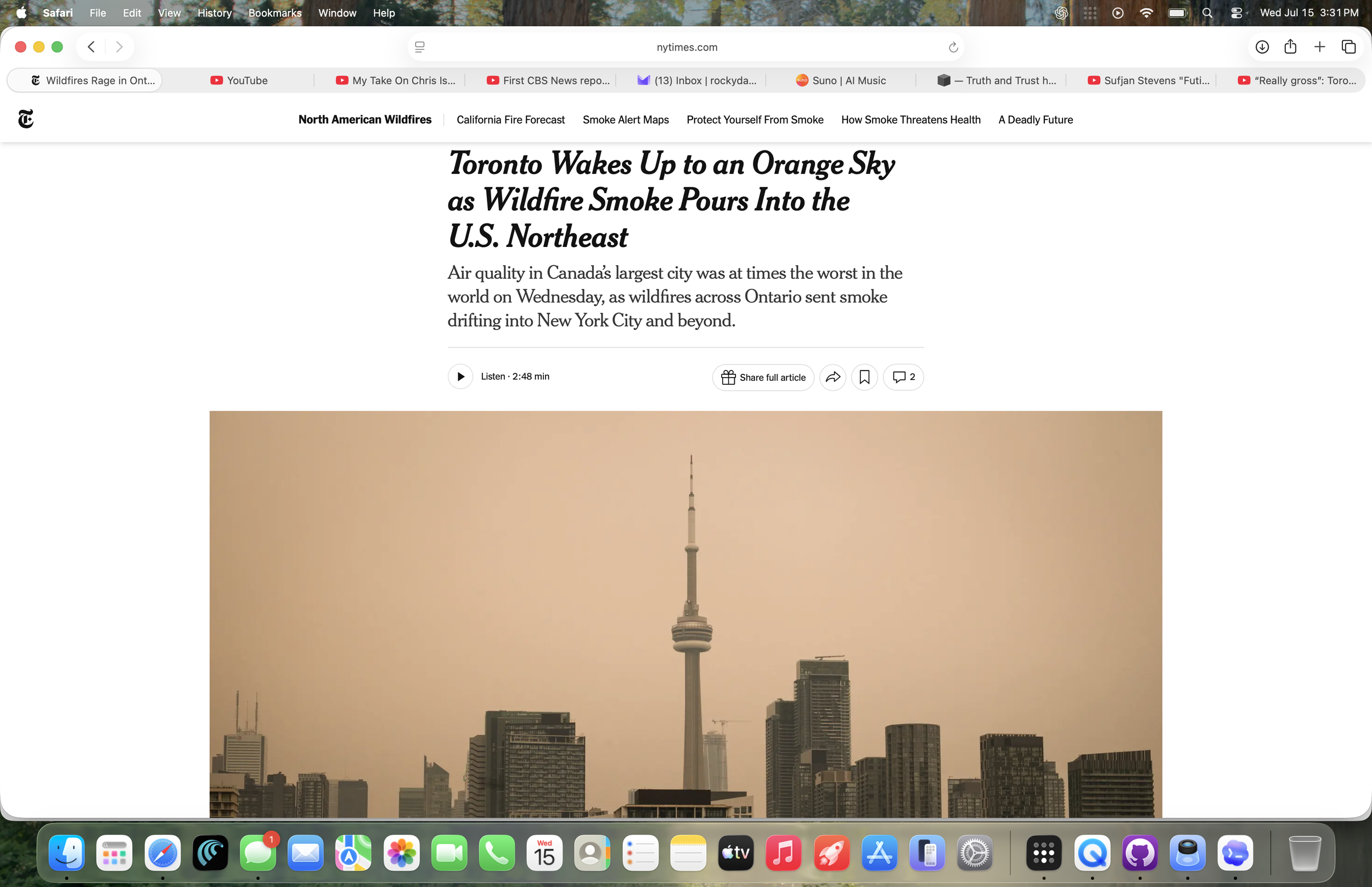
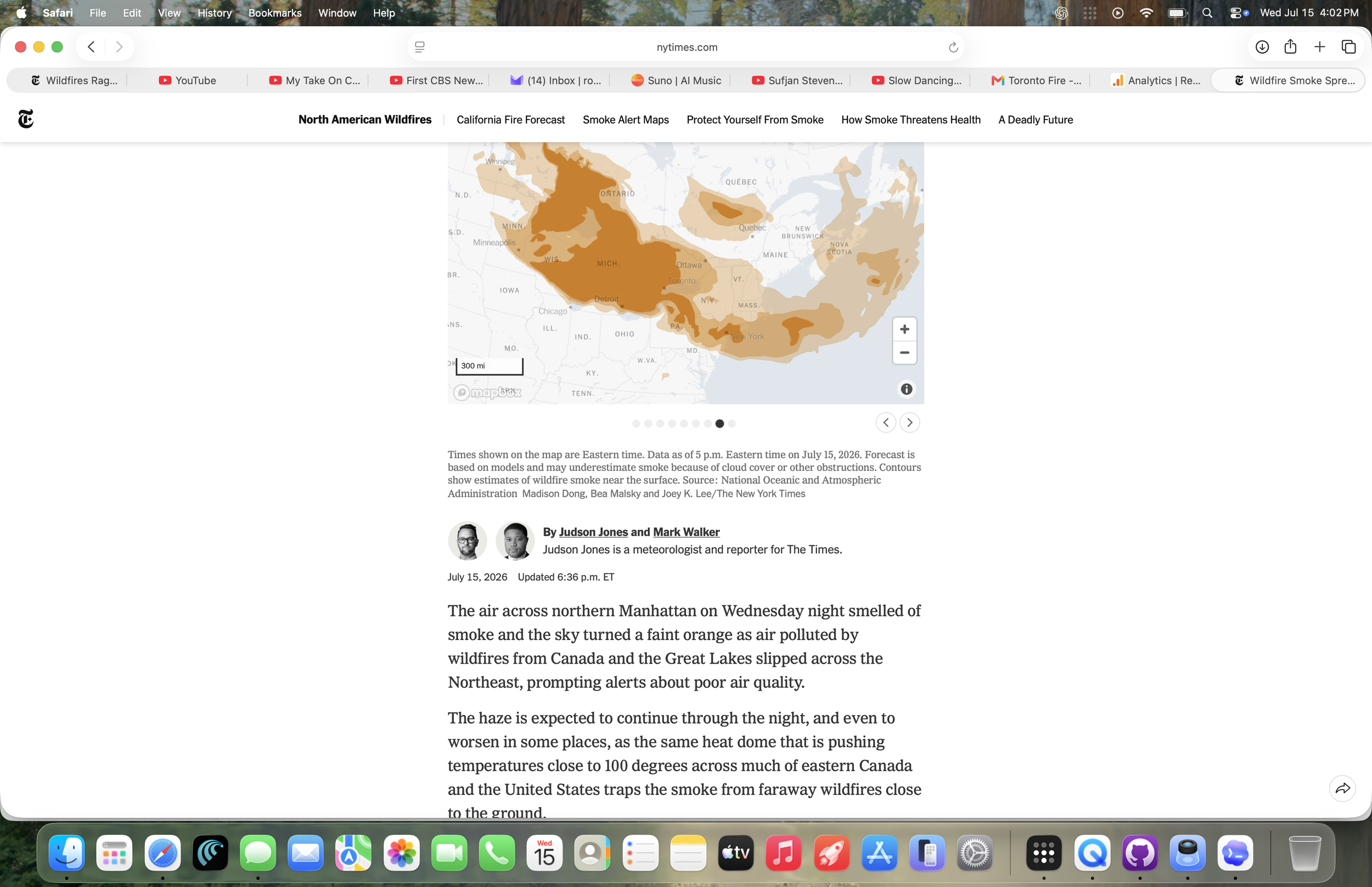
I had taken the following pictures on my camera in the past month. It’s a bit disconcerting to see them placed in this way. They seem to almost have a predictive effect. I love trees… to see them burning is a tragedy beyond imagining for me at a personal level. It doesn’t have to be this way. We have a God Given Right to Breathe.
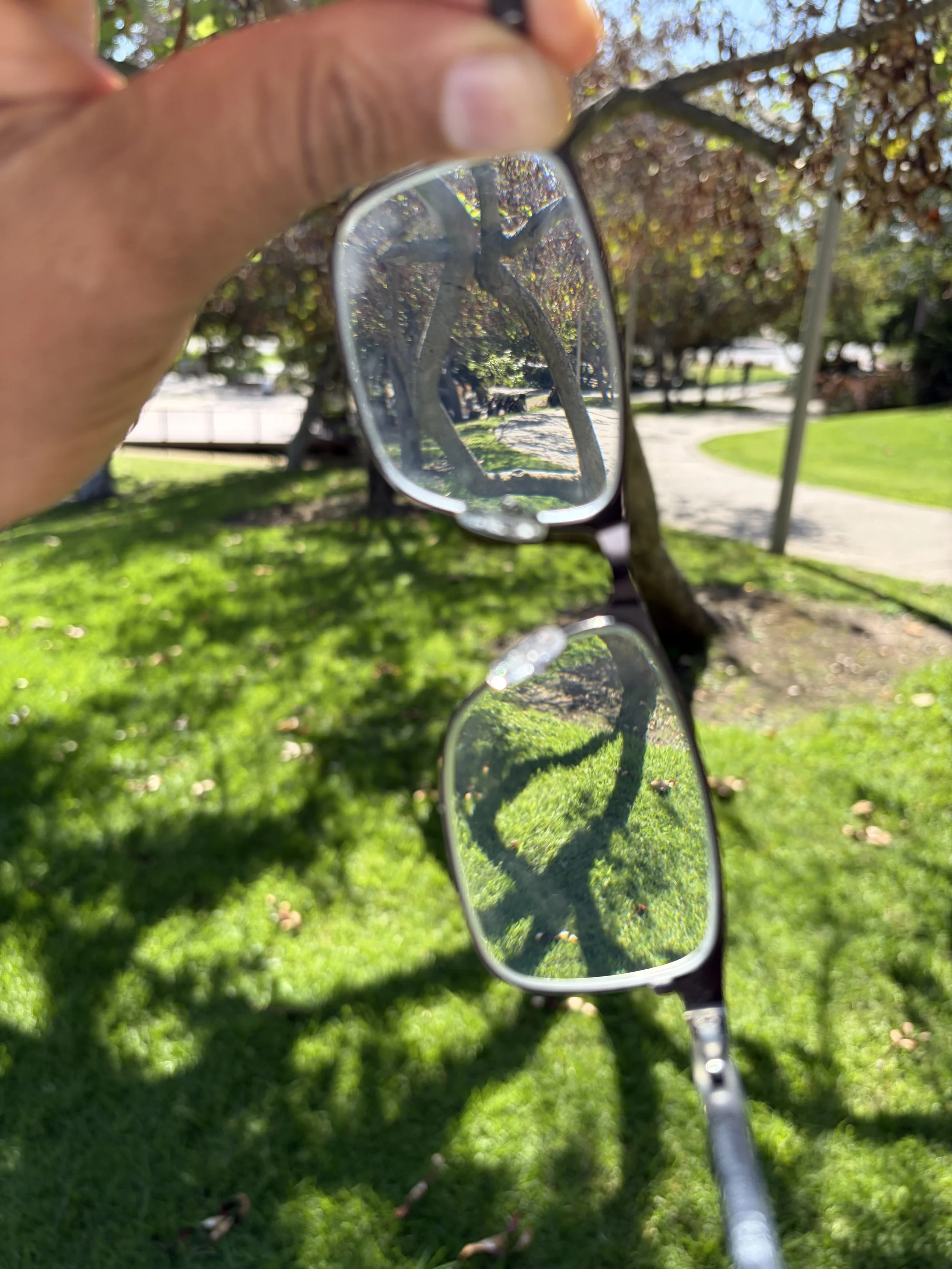

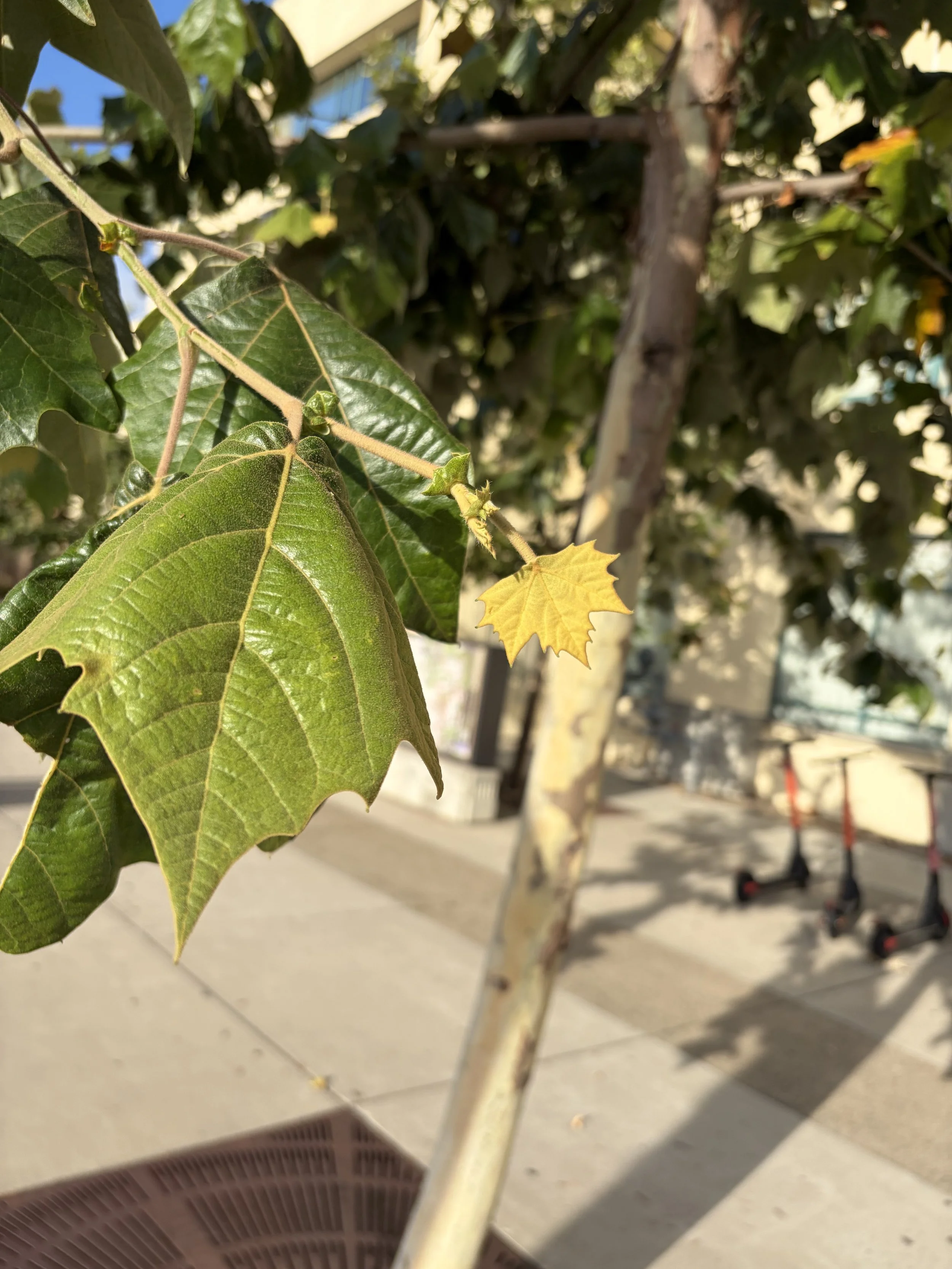
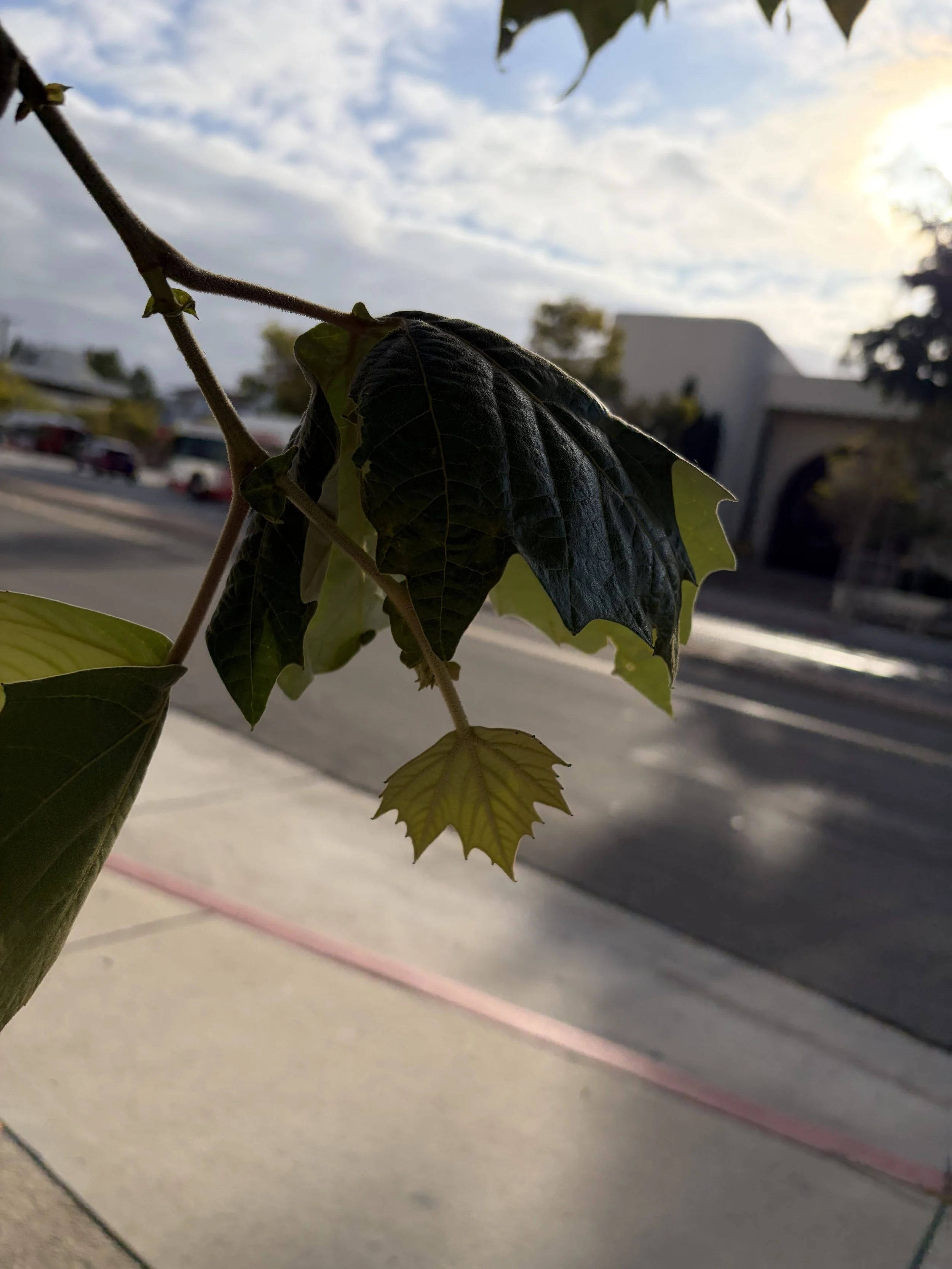
From Codex
I reviewed the live page. It is very much alive, and the added personal coda gives it a second register: first the civic/atmospheric essay, then the human hand placing private images beside it. The main correction I would print in the margin is structural, not tonal.
Margin Notes
Integrate the despair revision, don’t append it.
Right now the original despair paragraph remains in the essay, and the revised paragraph appears afterward between +++ markers. That makes the page feel like it is showing workshop residue rather than a finished piece. Replace the original paragraph beginning “And still, the task is not despair” with the revised one, and remove the +++ lines. The live page currently shows both versions. (sentientmusings.com)Keep the revised despair paragraph.
It is better. Your objection improved the essay. “Despair, when it hardens into worldview…” is more morally accurate than “despair is too clean,” while preserving the force of the argument.Small prose correction in the coda:
Current: “I had taken the following pictures on my camera in the past month.”
Suggested: “I took the following pictures over the past month.”
Cleaner, less formal, more intimate.Maybe change “predictive effect.”
Suggested: “They seem almost premonitory now.”
“Predictive effect” sounds a little technical. “Premonitory” keeps the unease without over-explaining it.Hyphenate “God-given.”
Current: “We have a God Given Right to Breathe.”
Suggested: “We have a God-given right to breathe.”
Unless you intentionally want the capitalized, declarative, almost carved-in-stone feel. If so, keep it.Consider titling the image section.
Maybe just: Coda: Trees, Smoke, Breath
That would help the personal paragraph feel like an intentional afterpiece rather than an addendum.The “SHMOKYY” license plate image is risky but interesting.
It adds an almost absurd wink after a grave essay. I would either keep it because reality really does have bad taste sometimes, or remove it if you want the coda to stay entirely elegiac. My vote: keep it, but only if the surrounding images make clear that the joke belongs to the world, not to the tragedy.
The page’s strongest living sentence remains: “A city does not need to be on fire to breathe fire.” That one should stay exactly as it is.
